
中文
中文
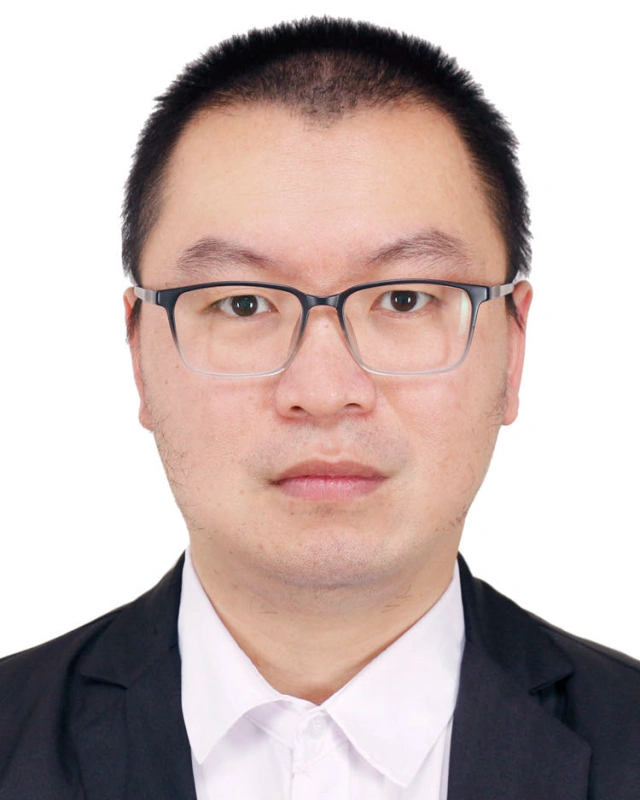
Personal Biography
Qiaoming Wang, Ph.D., is currently a researcher at the Shenzhen Institute for Quantum Science and Engineering. With extensive experience in quantum computing chips and semiconductor devices, he has been engaged in postdoctoral and assistant research roles at the Southern University of Science and Technology and Washington State University since 2016. His research focuses on spin qubit devices and chips, silicon-based quantum computing, micro/nano-fabrication, and the preparation, processing, and measurement of semiconductor devices. He has made significant contributions to the processing of semiconductor heterostructure devices, low-temperature quantum transport phenomena, and magnetic measurements, and has participated in multiple projects funded by the U.S. National Science Foundation (NSF) and the National Natural Science Foundation of China.
Dr. Wang is proficient in various semiconductor processing and characterization techniques, including CVD, ALD, electron beam evaporation deposition, optical and electron beam lithography, and etching. He is also skilled in low-temperature quantum transport and magnetic measurement techniques. An accomplished scholar, he has published multiple high-impact papers in prestigious journals such as Physical Review X. In recognition of his outstanding research capabilities and academic achievements, he was awarded the "Peacock Plan" Talent title by the Shenzhen Municipal Government in 2018.
Education Background
PhD in Department of Physics and Astronomy, Washington State University, 2016
Master in Department of Physics and Astronomy, Washington State University, 2012
Master in Department of Modern Physics, University of Science and Technology of China, 2009
Bachelor in Department of Modern Physics, University of Science and Technology of China, 2005
Working Experience
Researcher, Shenzhen International Quantum Academy, November 2022 – Present
Research Assistant Professor, Shenzhen Institute for Quantum Science and Engineering, October 2020 – November 2022
Post-Doctor in Prof. Yue Zhao’s group, Southern University of Science and Technology, June 2017 – September 2020
Research Assistant in Dr. Yi Gu’s group, Washington State University, December 2016 – June 2017
Papers and Patents
1. “一种基于Ge/GeSi平面衬底结构的硅基量子器件及其制备方法”, Zhen Tian, Qiaoming Wang, Guangchong Hu, Yuning Zhang, Hao Wang, Yongfeng Mai, Yu He, 2025102553708.
2. Xiaohua Wu, Yujun Zhang, Qiaoming Wang, Gaomin Li, Shenghai Pei, Shoujing Chen, Junyang Chen, Yue Zhao, and Mingyuan Huang*. “The coupling between the interlayer magnetic order and Davydov splitting modes in few-layer CrI3”. Applied Physics Letters, 2023, 123: 052406.
3. Xuefeng Wu, Jiayu Li, Xiaoming Ma, Yu Zhang, Yuntian Liu, Chunsheng Zhou, Jifeng Shao, Qiaoming Wang, Yujie Hao, Yue Feng, Eike F. Schwier, Shiv Kumar, Hongyi Sun, Pengfei Liu, Kenya Shimada, Koji Miyamoto, Taichi Okuda, Kedong Wang, Maohai Xie, Chaoyu Chen, Qihang Liu, Chang Liu, Yue Zhao, “Distinct Topological Surface States on the Two Terminations of MnBi4Te7”, Physical Review X 10, 031013 (2020).
4. Haiyang Pan, Qiaoming Wang, Xiaohua Wu, Tingting Song, Qiuming Song, Jue Wang, “Thermal Annealing Effect on the Electrical Quality of Graphene/Hexagonal Boron Nitride Heterostructure Devices”, Nanotechnology 31, 55 (2020).
5. Wei Zeng, Xiaoming Tao, Shuping Lin, Ching Lee, Dongliang Shi, Kwokho Lam, Baoling Huang, Qiaoming Wang, Yue Zhao, “Defect-Engineered Reduced Graphene Oxide Sheets with High Electric Conductivity and Controlled Thermal Conductivity for Soft and Flexible Wearable Thermoelectric Generators”, Nano Energy 54, 163 (2018).
6. Qiaoming Wang, Liangliang Yang, Shengwen Zhou, Xianjun Ye, Zhe Wang, Wenguang Zhu, Matthew McCluskey, and Yi Gu, “Phase-Defined Van der Waals Schottky Junctions with Enhanced Thermoelectric Properties”, The Journal of Physical Chemistry Letters 8, 13, 2887 (2017).
7. Qiaoming Wang, Xin Tao, Liangliang Yang, and Yi Gu, “Current Crowding in Two-Dimensional Black-Phosphorus Field-Effect Transistors”, Applied Physics Letters 108, 103109 (2016).
8. Qiaoming Wang (co-first author), Liangliang Yang, Xin Tao, Shelby Taylor, and Yi Gu, “Gate-Tunable Photocurrent in ZnO Nanowires Mediated By Nanowire-Substrate Interface States”, Applied Physics Letters106, 093111 (2015).
9. Qiaoming Wang, and Yi Gu, “Effects of Geometrical Parameters on the Efficiency of CuInSe2 and CdS core-shell Nanowire Solar Cells”, Applied Physics Letters, Prepared to be submitted.
10. Qiaoming Wang, and Gary S. Collins, “Nuclear Quadrupole Interactions of 111 In/Cd Solute Atoms in a Series of Rare-Earth Palladium Alloys”, Hyperfine Interactions 221, 85 (2013).
11. Cheng-Han Hsu, Qiaoming Wang, Xin Tao, and Yi Gu, "Electrostatics and Electrical Transport in Semiconductor Nanowire Schottky Diodes", Applied Physics Letters 101, 183103 (2012).
12. Xiaoyan Sun, Rui Jiang, Qiaoming Wang, and Binghong Wang, “Influence of Traffic Bottleneck on Two-Route Scenario with Mean Velocity Information Feedback”, International Journal of Modern Physics C 21, 695 (2010).
13. 2. Qiaoming Wang, Rui Jiang, Xiaoyan Sun, and Binghong Wang, “Assigning on-ramps’ Flows to Maximize Highway Capacity”, Physica A 388, 3931-3938 (2009).
14. Xiaoyan, Sun, Binghong Wang, Hanxin Yang, Qiaoming Wang, and Rui Jiang, “Effect of Information Feedback on an Asymmetrical Two-Route Scenario”, Chinese Science Bulletin 54, 3211-3214 (2009).
Honors and Awards
Shenzhen Overseas High-level Talent Peacock Plan, Type C, 2018