
中文
中文
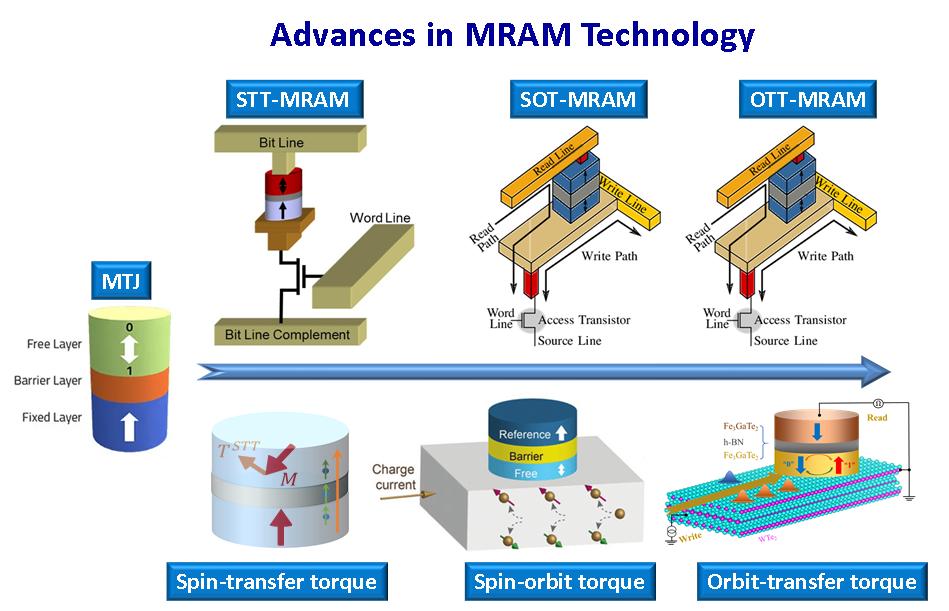
The MRAM technology from STT, SOT to OTT
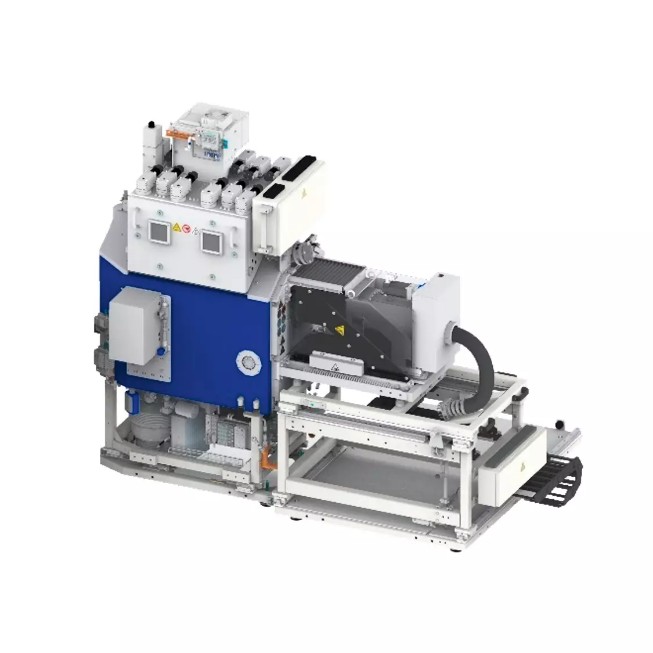
A high-performance sputtering system designed for precision thin-film deposition in nanoscale fabrication.
The Magnetic Memory Nano-Fab Platform is dedicated to advancing cutting-edge magnetic memory technologies, with a focus on developing next-generation spintronic memory devices that offer ultra-low power consumption, high-density integration, fast write/read speeds, and exceptional endurance. The magnetic random-access memory (MRAM), unlike conventional static random-access memory (SRAM) and dynamic random-access memory (DRAM), is a non-volatile storage technology that retains data without power. This non-volatility positions MRAM as a promising enabler for in-memory computing and neuromorphic computing, promising to significantly accelerate artificial intelligence workloads.
Currently, the mainstream MRAM technology landscape is dominated by three key approaches: toggle-MRAM, spin-transfer torque (STT) MRAM, and spin-orbit torque (SOT) MRAM. Among these, toggle-MRAM, as the first-generation technology, faces challenges such as high power consumption and complex device structures. The second-generation STT-MRAM achieves lower power operation but suffers from limited endurance. While SOT-MRAM offers advantages in both endurance and power efficiency, it typically requires an external magnetic field to assist data writing, a constraint that hinders its practical application.
This platform is dedicated to advancing next-generation MRAM technology—specifically, orbital-transfer torque (OTT) MRAM. Leveraging the orbital degree of freedom, OTT-MRAM enables field-free perpendicular magnetic switching, thereby offering an energy-efficient, high-density storage solution with exceptional endurance and rapid write speeds. To date, we have demonstrated nanosecond field-free OTT switching with a power density significantly lower than that of SOT-MRAM. The related work has been published in leading academic journals such as Physical Review Letters (Editor’s suggestion), Science Bulletin (Cover story), and Chinese Physics Letters (Cover story & Express Letter), and has resulted in multiple national and PCT patents.