
中文
中文
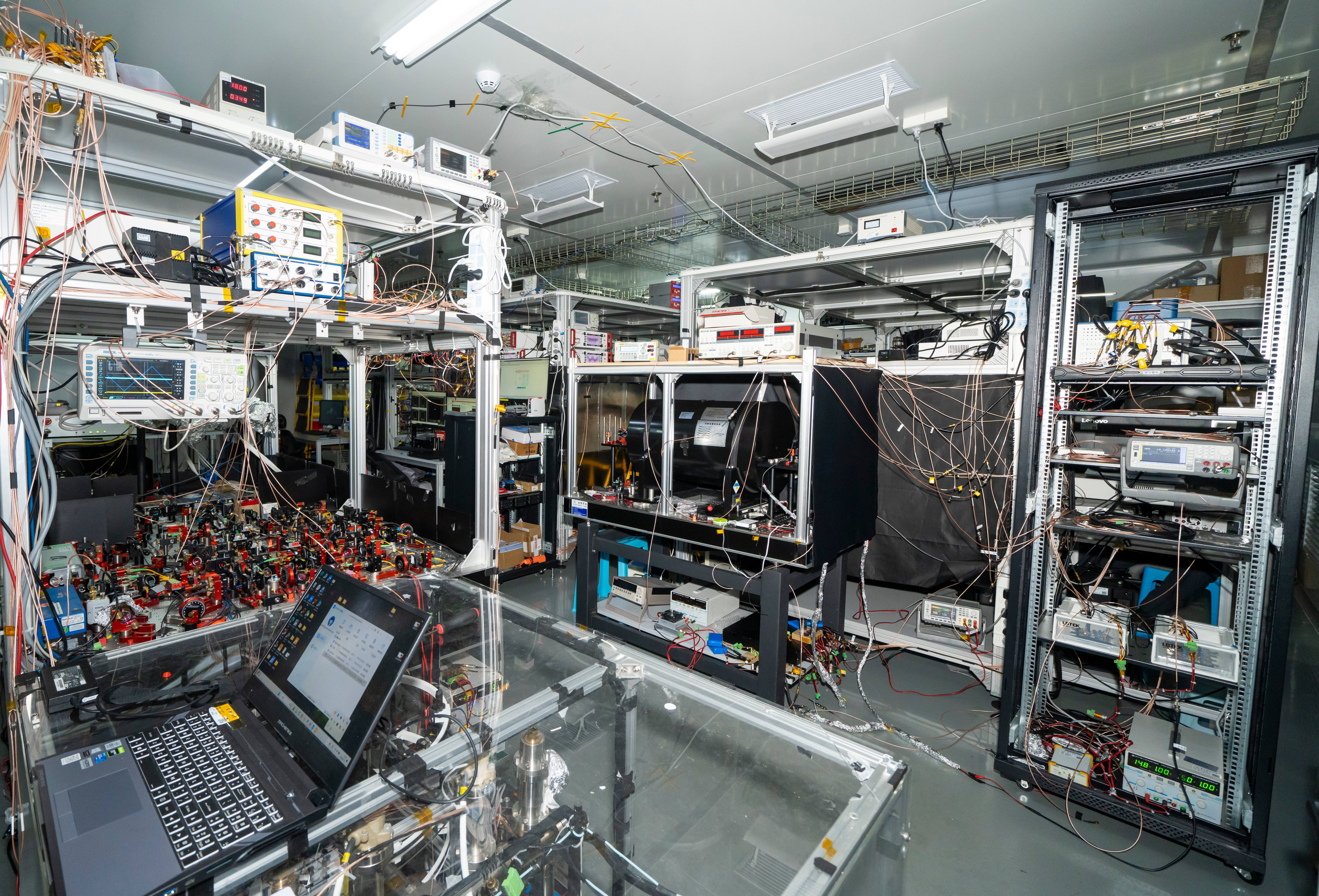
Panoramic view of the laboratory
The Atomic Sensing Laboratory focuses on precision measurements of gravitational and magnetic fields using atomic vapor cells and ultracold atoms, and on developing high-performance, transportable quantum sensors, including the atom gravimeter/accelerator/gradiometer and the atom scaler/vector magnetometer. Our long-term goal is to apply these quantum sensors to field applications such as integrated inertial and geomagnetic navigation, geophysics and mineral exploration. It explores quantum-enhanced schemes and optimal control strategies for high-sensitivity, high-accuracy atomic sensors. Rather than solely pursuing the ultimate sensitivity and accuracy in the lab, specific requirements for the SWaP (Size, Weight, and Power), bandwidth, dynamic range, and environmental robustness in practical applications will be addressed.
After years of effort, our R&D platform has been established, including experimental setups for magnetic-field measurements with room-temperature atomic vapor cells and for atomic interferometry with cold atoms and ultracold Bose condensation. The experimental demonstration and prototype development of atomic interferometers and atomic magnetometers are essentially complete. We have successfully demonstrated degenerate cavity-assisted Raman-type atomic interferometry for absolute gravity measurement [2], aiming to achieve an atomic gravimeter with low laser power consumption and large interference loop area while maintaining robustness suitable for operation in dynamic environments. Our lab has also developed a single-beam all-optical NMOR (nonlinear magneto-optical rotation) atomic magnetometer, which implements an iterative search and intensity-modulation feedback-locking scheme for the unknown magnetic field [3]. We are continuing to explore new solutions to improve the performance metrics of these atomic sensors. Currently, the lab is accelerating the engineering development of related atomic sensors.
Publication:
[1] Z.-X. Duan et al., Observation and Analysis of the Center-of-Mass Position Trajectory for Trapped Ultracold Atoms, Chin. Phys. B in press (2025), DOI: 10.1088/1674-1056/ae15f9.
[2] L. Yuan et al., Raman-type absolute atom gravimeter assisted by a degenerate optical cavity, Phys. Rev. A 111, L021303 (2025), DOI: 10.1103/PhysRevA.111.L021303.
[3] W. Zhang et al., Magnetic field search and locking scheme for all-optical single-beam atomic magnetometer, Chin. Opt. Lett. 23, 021201 (2025), DOI: 10.3788/COL202523.021201.
[4] W.-T. Wu et al., Observation of collapse and revival of atomic four-wave mixing in Bose gases, Phys. Rev. A 109, 063316 (2024), DOI: 10.1103/PhysRevA.109.063316.
[5] L. Yuan et al., Current Status and Prospects on High-Precision Quantum Tests of the Weak Equivalence Principle with Cold Atom Interferometry, Symmetry 15, 1769 (2023), DOI: 10.3390/sym15091769.
[6] Z.-X. Duan et al., Simple and active magnetic-field stabilization for cold atom experiments, Rev. Sci. Instrum. 93, 123201 (2022), DOI: 10.1063/5.0119778.