
中文
中文
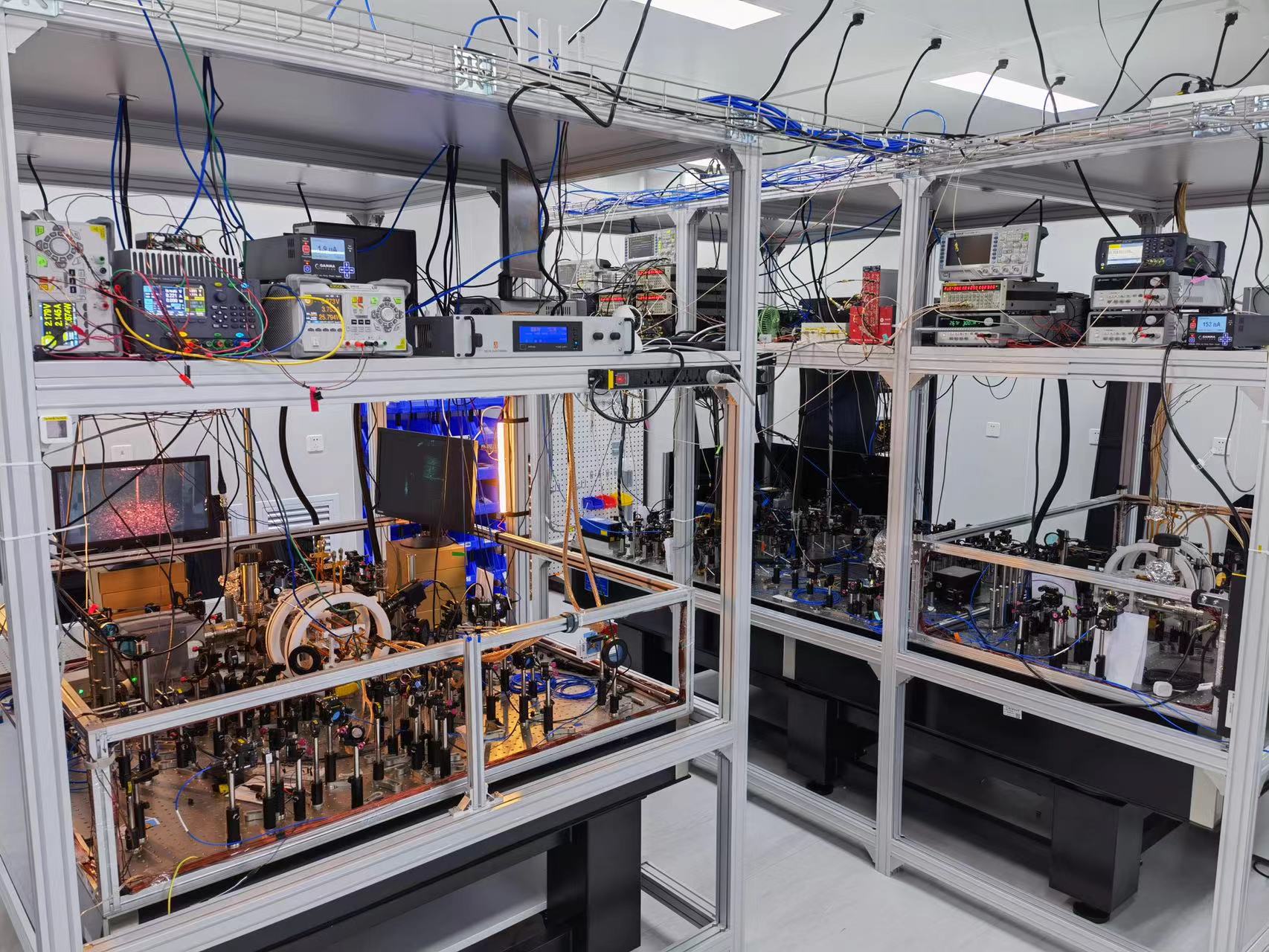
Quantum optics and cold atomic platform
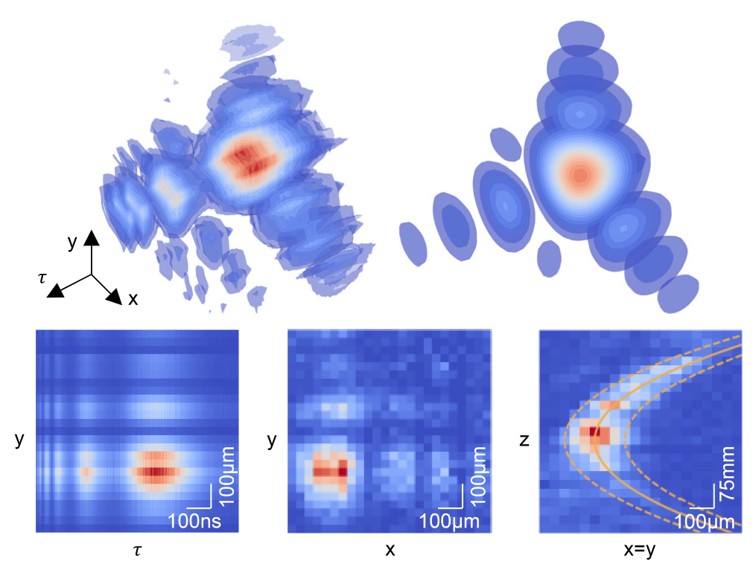
Experimental plot (Left upper) compared with theoretical (Right upper) single-photon (2+1)D Airy bullet.
This platform is dedicated to the high-efficiency generation and coherent storage of quantum states using cold ensembles. The system operates within a specialized ultra-high vacuum environment, utilizing a high-flux 2D-MOT to load a cigar-shaped atomic cloud with an optical depth (OD) reaching 300 and a peak atomic density of 1011cm−3. By integrating high-power 780 nm laser systems, magnetic field compensation and optimized anti-Helmholtz configurations, the platform provides a highly stable medium for complex light-matter interactions.
Our system has successfully demonstrated high-performance quantum storage of entangled states with an efficiency exceeding the 50% criterion, overcoming the fundamental limits required for practical quantum memory. Our medium-to-long-term roadmap focuses on the interconnection of multiple atomic ensembles. By scaling up these discrete quantum nodes, we aim to construct a fully functional quantum repeater-based link, ultimately realizing a distributed quantum network for long-distance, high-fidelity quantum communication.
This platform is also developed to generate deterministic photon sources, and carry out the simulation of many-body physics, leveraging the long-range interactions of Rydberg atoms. The Rubidium atoms prepared in a 3D-MOT and subsequently loaded into a far-detuned optical dipole trap. Our laser system utilizes versatile two-photon excitation scheme, enabling precise spectroscopic access to a broad range of Rydberg states from n=10−120. To ensure long-term phase coherence, the excitation lasers are frequency-stabilized via Pound-Drever-Hall (PDH) locking to ultra-stable reference cavities with a Finesse exceeding 100,000.
Through high-resolution optical systems, we achieve tight confinement of atomic ensembles with spatial dimensions significantly smaller than the Rydberg blockade radius. These ensembles, typically containing several hundred atoms, allow us to exploit the collective Rydberg blockade effect for the generation of deterministic single photons and magnons. Our current research is directed towards demonstrating quantum network protocols and magnon interference, providing a scalable path for simulating complex many-body phenomena. Our ultimate objective is to explore practical quantum advantage and address the challenges of interconnecting neutral-atom quantum computing platforms, laying the groundwork for scalable and fault-tolerant quantum information processors.
Recent achievements highlight spatial-temporal single-photon Airy bullet, which is the proof of principle to demonstrate airy bullet in quantum regime. The Airy bullet serves as an optical mode for safeguarding the quantum information carried by quantum photon source. The results are published by Physical Review Letters in 2024 and selected as Editors’ suggestion. Later on, the paper is among one of the 56 articles in the PRL 2024 selection. The article is found at https://doi.org/10.1103/PhysRevLett.132.143601.