
中文
中文
Recently, in collaboration with Southern University of Science and Technology, Zhejiang University, and other institutions, Associate Researcher Le Wang from the Shenzhen International Quantum Academy, achieved the Bose-Einstein condensation (BEC) of two-magnon bound states in the two-dimensional triangular lattice spin-1 quantum magnet Na2BaNi(PO4)2 for the first time. This work revealed its quantum critical behavior and connection to the hidden order—the spin nematic (SN) phase. This breakthrough not only provides crucial experimental evidence for many-body physical phenomena in low-dimensional quantum magnetic systems, but also highlights the unique advantages of this material in quantum material design and control. The related work was published online on January 20, 2025, in the international academic journal Nature Materials, under the title “Bose-Einstein condensation of a two-magnon bound state in a spin-1 triangular lattice”.
In ordered magnets, spin waves (magnons) are fundamental excitations that obey Bose-Einstein statistics. Similar to Cooper pairs in superconductors, magnons can form bound states under attractive interactions. Theoretical predictions suggest that the Bose-Einstein condensation of a two-magnon bound state at zero temperature corresponds to a new quantum phase transition, namely the spin nematic (SN) state. However, experimental evidence for two-magnon condensation and the associated SN phase has been lacking until now.
In this study, the research team focused on the specific structural features of the Na2BaNi(PO4)2 material system. Its crystal space group is P-3m1, with Ni2+ ions forming an equilateral triangular network within the ab plane, constituting a two-dimensional magnetically frustrated triangular lattice, with simple A-A-A stacking along the c-axis. This structure exhibits strong in-plane nearest-neighbor exchange interactions (J ≈ 0.032 meV) and weak interlayer coupling, resulting in a quasi-2D character, making it an ideal platform for studying low-dimensional quantum magnetism (e.g., fractionalized excitations, quantum criticality). The uniaxial anisotropy (D/J ≈ 3.97), realized through a stretched octahedral crystal field, stabilizes the formation of the two-magnon bound state and suppresses the appearance of higher-order multi-magnon bound states. Furthermore, the material’s low saturation field (~1.8 T) makes it an ideal system for experimentally studying quantum critical points. Compared to traditional high-saturation field materials (such as some copper oxides), its magnetic field conditions are easier to achieve in a laboratory, significantly reducing experimental difficulty. The low saturation field also ensures the possibility of precisely extracting microscopic Hamiltonian parameters (e.g., exchange J, anisotropies Δ and D) via inelastic neutron scattering (INS) within the fully polarized (FP) phase, promoting the verification of theoretical predictions and laying the groundwork for subsequent quantum phase transition analysis.
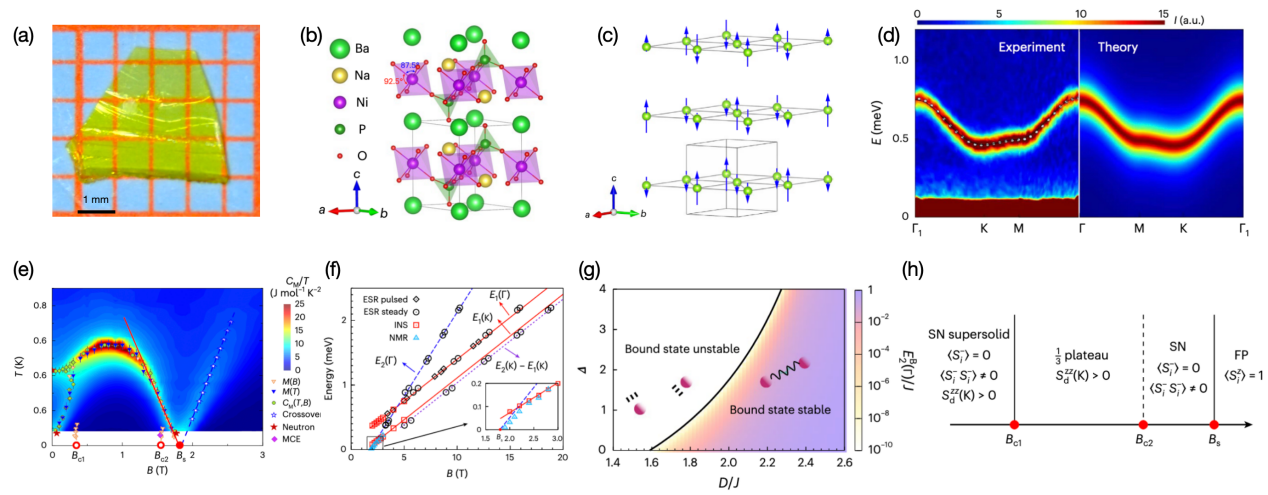
Figure 1. Crystal structure, magnetic structure, single-magnon dispersion, and Bose-Einstein condensation of the two-magnon bound state in Na2BaNi(PO4)2
Through magnetization and specific heat measurements, the researchers detected a one-third magnetization plateau and quantum critical point at ultralow temperatures (50 mK). Combined with scaling analysis (T ∝ |B−Bs|νz), the universality class of the 2D BEC was determined (ν=1/2, z=2). Neutron scattering revealed the non-collinear magnetic structure at zero field and the single-magnon dispersion in the polarized phase, confirming the quasi-2D nature. Using electron spin resonance (ESR) and nuclear magnetic resonance (NMR), with a tilted magnetic field to break U(1) symmetry, the researchers directly observed the excitation spectrum of the two-magnon bound state, verifying its stability and condensation behavior. The Lippmann-Schwinger equation was employed to precisely solve the two-magnon bound state energy spectrum. Combined with projection onto a hard-core Bose-Hubbard model, this revealed the competition between supersolid and spin nematic (SN) phases in the low-energy effective model. Density Matrix Renormalization Group (DMRG) calculations further supported the experimental phase diagram, confirming the phase transition mechanism dominated by two-magnon condensation at the quantum critical point Bs. The combination of multi-scale experimental techniques and precise mapping to theoretical models provides strong experimental evidence and theoretical support for the observed Bose-Einstein condensation of the two-magnon bound state.
As the first two-dimensional triangular lattice material to realize BEC of two-magnon bound states, Na2BaNi(PO4)2, through its unique structure and low-field quantum tunability, opens new avenues for understanding many-body effects and hidden orders in low-dimensional quantum magnetism. This achievement not only advances the development of condensed matter physics theory, but also provides new directions for exploring hidden order materials, offering technical references for the future development of novel quantum magnets (such as topological magnets and quantum spin liquids).
The co-first authors of this research are Dr. Jieming Sheng (now Assistant Professor at Great Bay University), Associate Professor Jiawei Mei of Southern University of Science and Technology, and Dr. Le Wang of the Shenzhen Quantum Science and Engineering Research Institute (now Associate Researcher at the Shenzhen International Quantum Academy). Liusuo Wu, Jiawei Mei, Weiqiang Yu, Dehong Yu, and Zhentao Wang are the co-corresponding authors. This work was supported by the National Key R&D Program of China and the National Natural Science Foundation of China.
Paper link: https://doi.org/10.1038/s41563-024-02071-z