
中文
中文
Recently, the group led by associate researcher Jilei Chen and assistant researcher Lutong Sheng at the Shenzhen International Quantum Academy (SIQA), in collaboration with Prof. Dirk Grundler’s group at EPFL (Switzerland) and Prof. Haiming Yu’s group at Beihang University, has achieved a major breakthrough in the chiral control of spin currents in antiferromagnets. For the first time, they experimentally observed coherent interference of antiferromagnetic spin waves in α-Fe2O3. By innovatively combining electrical and optical measurement techniques, the researchers systematically revealed the interference fringe patterns of spin waves in both the frequency and space domains. More importantly, they demonstrated a breakthrough capability to precisely control the chirality of the output spin current by tuning the spin-wave frequency. This achievement was published on April 23, 2025, in Nature Physics under the title “Control of spin currents by magnon interference in a canted antiferromagnet” (DOI: 10.1038/s41567-025-02819-7)
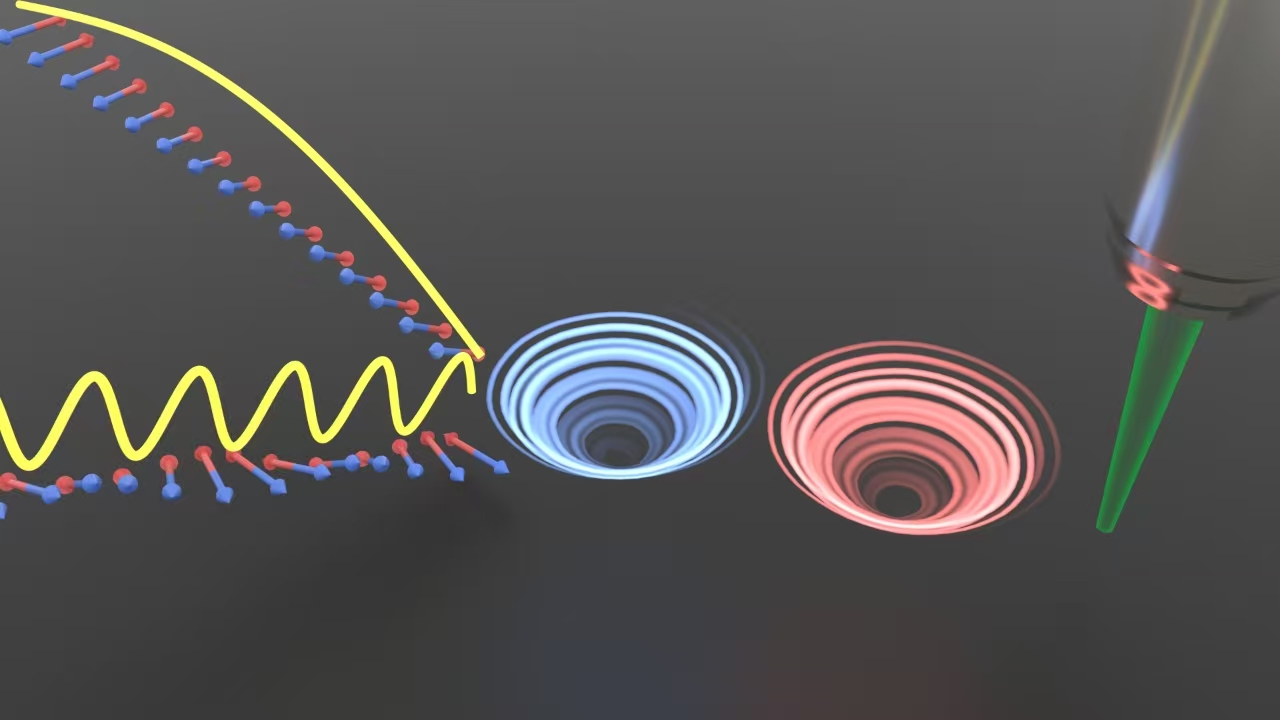
Controlling the spin current lies at the heart of spintronics and its applications. In ferromagnetic materials, due to the breaking of time-reversal symmetry, spin currents generated by the spin-pumping effect necessarily possess right-handed chirality. In contrast, antiferromagnets intrinsically host two sublattices with opposite chiralities, offering a unique platform for manipulating spin-current chirality. In this work, spin-wave interference in an antiferromagnet is exploited for the first time to achieve controllable chirality of spin currents, offering a new approach to tuning spin-current chirality without altering the external magnetic field or temperature. Thus, this work opens up new possibilities for antiferromagnetic-chirality-based logic operations and computing technologies.
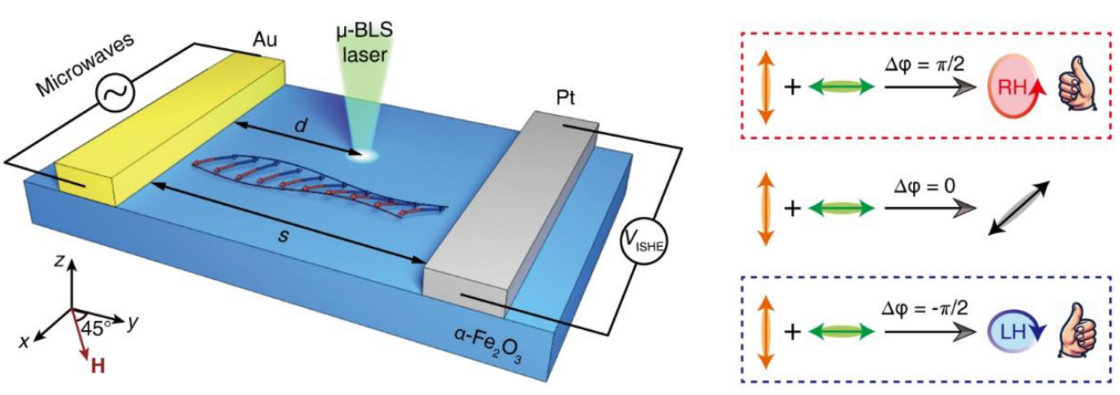
Fig1. Schematic illustration of the antiferromagnetic spin-wave device and the spin-wave interference mechanism
In this study, precise control of spin-current chirality was successfully achieved at room temperature through coherent spin-wave interference in the antiferromagnetic system α-Fe2O3. Experimentally, the research team employed high–spatial-resolution microfocus Brillouin light scattering (μBLS) microscopy to directly observe, for the first time, clear interference patterns formed by antiferromagnetic spin waves. In parallel, an innovative electrical approach was used to distinguish right-handed and left-handed spin currents by analyzing the oscillatory signs of the voltage generated via the inverse spin Hall effect (ISHE). Theoretical analysis reveals that the interference between two linearly polarized spin-wave modes originates from the phase delay accumulated during their propagation, a key physical mechanism that directly governs the periodic modulation of spin-current handedness. Through complementary verification using μBLS imaging and electrical detection, this work establishes a highly controllable mechanism for spin-current generation based on spin-wave interference in antiferromagnets. Moreover, the proposed frequency-controlled tuning of spin-current polarization provides new insights into the development of programmable nanomagnetic switching technologies based on magnonic spin angular momentum.
This breakthrough not only deepens the understanding of antiferromagnetic spin dynamics, but also opens new research directions for the emerging field of coherent antiferromagnetic spintronics, demonstrating significant potential for the development of low-power spintronic devices.
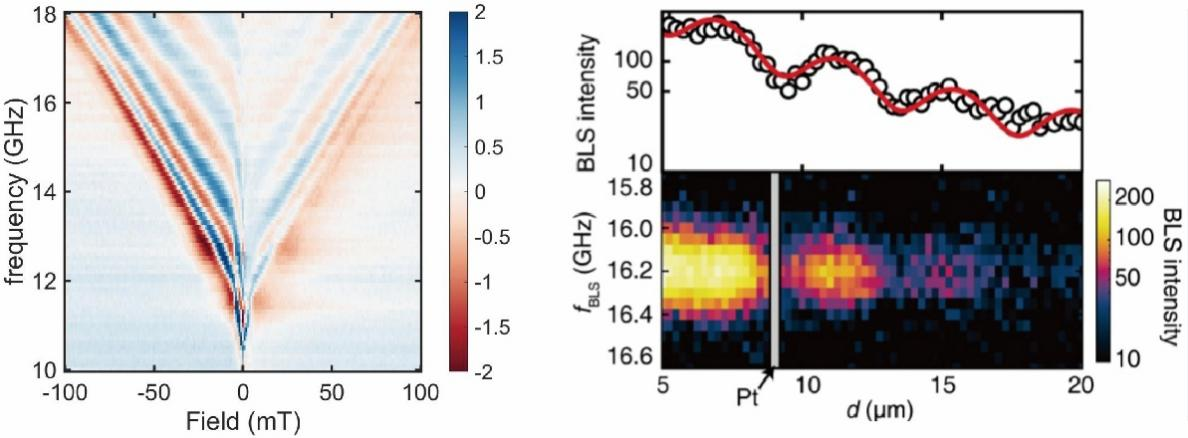
Figure 2. Interference fringes of antiferromagnetic spin waves in the frequency and spatial domains and the corresponding chirality variation
The first authors of this work are Assistant Researcher Lutong Sheng (SIQA), Anna Duvakina (PhD student, EPFL), Hanchen Wang (PhD student, ETH Zurich; former visiting student at the SIQA), Kei Yamamoto (Researcher, RIKEN, Japan), and Rundong Yuan (PhD student, University of Cambridge). The corresponding authors are Prof. Dirk Grundler (EPFL) and Prof. Haiming Yu (Beihang University). This work was supported by the National Key Research and Development Program of China, the National Science Foundation of China, the Department of Science and Technology of Guangdong Province, and other funding agencies.
Paper link: https://www.nature.com/articles/s41567-025-02819-7