
中文
中文
Recently, the research group led by Associate Researcher Jilei Chen, in collaboration with international partners, achieved an important advance in antiferromagnetic spintronics. By exploiting nonlinear magnon excitation, the team realized deterministic switching of antiferromagnetic spin textures under ultra-low power conditions, providing a new control paradigm for next-generation low-power spintronic devices. The results were published online on July 1, 2025, in Nature Communications under the title “Deterministic switching of antiferromagnetic spin textures by nonlinear magnons.”
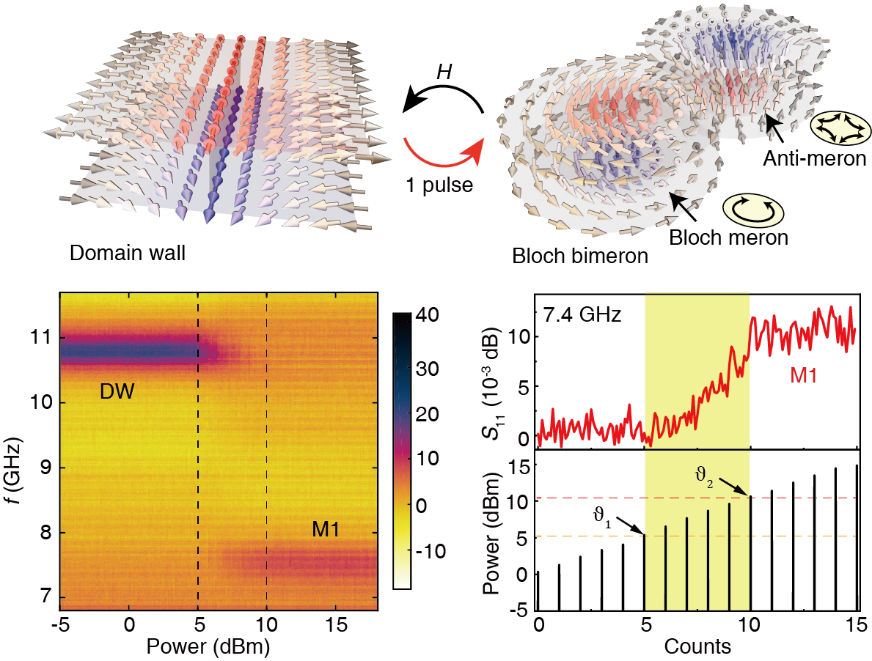
Figure 1. Nonlinear-magnon-induced switching of antiferromagnetic domain walls and its power dependence.
Compared with ferromagnetic materials, antiferromagnetic spin textures exhibit higher robustness against external perturbations and high-frequency dynamics compatible with ultrafast information processing. Magnons—the quantized excitations of spin waves—serve as low-energy information carriers, enabling spin transport without charge flow and thus significantly reducing energy dissipation in conventional electronic devices. In antiferromagnets, the high propagation speed and strong immunity to disturbances of magnons make them highly promising for ultra-high-density storage and quantum information processing. In this work, the Chen group employed nonlinear magnon excitation to achieve deterministic switching among three characteristic high-frequency antiferromagnetic spin states in single-crystal α-Fe₂O₃. Experiments show that all three states are highly stable, with full controllability verified over 1,000 switching cycles. By inducing local magnetization switching under nonlinear excitation, a single 100-ns microwave pulse—with an energy consumption of only 1 nJ—is sufficient to precisely switch from one stable state to the next.
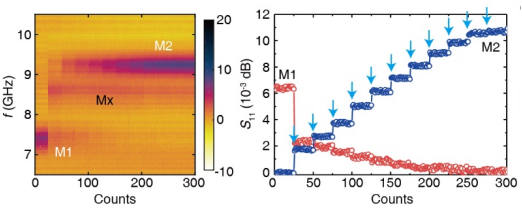
Figure 2. Simulated progressive switching of chiral antiferromagnetic domain structures and neuromorphic-computing-related behaviors.
Using Brillouin light scattering (BLS) imaging, the study observed magnon modes associated with antiferromagnetic domain walls and circular chiral spin textures, confirming the key role of nonlinear magnons in driving spin-texture switching. This switching mechanism features high controllability and reversibility, opening new avenues for ultrafast, low-power memory and computing devices based on antiferromagnetic materials. Moreover, the progressive switching among the three states resembles weighted-sum operations in neuromorphic computing, highlighting the potential of antiferromagnetic spin textures for neuromorphic information processing.
The first affiliation of this work is the Shenzhen International Quantum Academy. The first authors are Associate Researcher Jilei Chen and Dr. Mingran Xu (École Polytechnique Fédérale de Lausanne, EPFL). The corresponding authors are Professor Dirk Grundler (EPFL) and Professor Haiming Yu (Beihang University; visiting scholar at SIQA). Key collaborators include Prof. Dapeng Yu, Prof. Song Liu, and Prof. Tingyong Chen (Shenzhen International Quantum Academy), Prof. Patrick Maletinsky (University of Basel), and Prof. Jean-Philippe Ansermet (EPFL). This research was supported by the National Key R&D Program of China, the National Natural Science Foundation of China, and the Swiss National Science Foundation.
Link to the original paper: https://www.nature.com/articles/s41467-025-60883-2