
中文
中文
Recently, the research group led by Associate Researcher Jilei Chen, in collaboration with partners, has achieved significant progress in the study of long-distance propagation of chiral magnonic edge states. Through atomic-scale lattice strain engineering, the team successfully fabricated high-quality magnetic lanthanum–strontium manganite (LSMO) thin films. These films exhibit millimeter-scale antiferromagnetically coupled spin-spiral structures and low magnetic damping, enabling long-distance propagation of chiral magnonic edge states. The results were published online on January 3, 2025, in Nature Materials under the title “Switchable long-distance propagation of chiral magnonic edge states.”
Spin waves (whose quantized excitations are known as magnons) can transmit spin information without charge flow, thereby effectively avoiding Joule heating in highly integrated circuits. As a result, magnons are regarded as one of the key information carriers for next-generation ultra-low-power computing and memory technologies beyond Moore’s law. Moreover, as quasiparticles, magnons can couple with other quasiparticles—such as photons and phonons—to exchange information and form complex hybrid quantum systems, which are of great significance for emerging quantum devices.
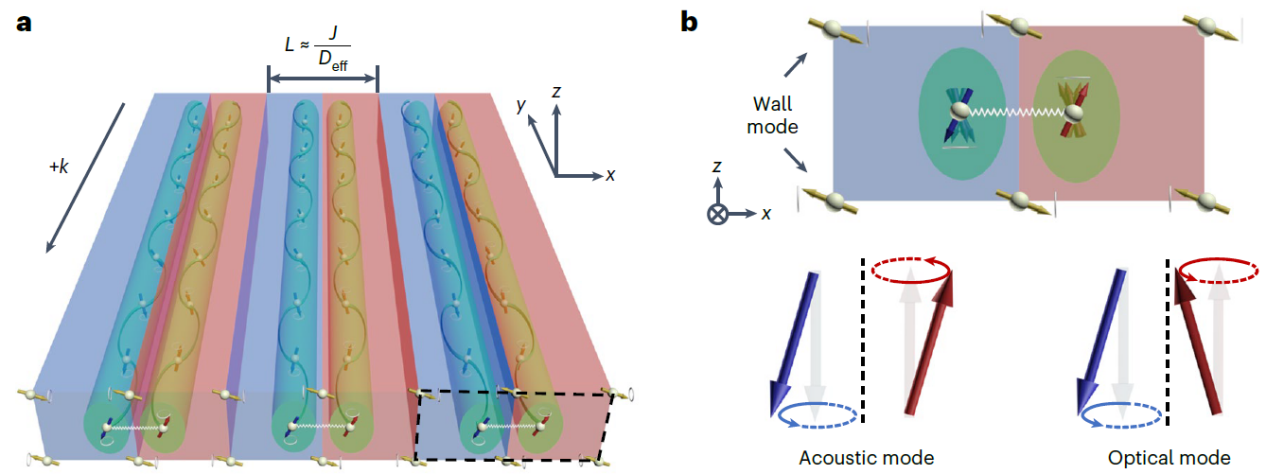
Figure 1. Magnon modes excited in spin-spiral structures engineered by atomic-scale lattice strain.
In this work, the team exploited dynamic dipolar interactions in spin systems to elucidate the formation mechanism of chiral magnonic edge states and their strong coupling with magnons in spiral magnetic textures. The researchers observed a hybrid magnon state with robust chirality, which can be reversibly switched by applying magnetic fields at different threshold angles. By examining the propagation of nonreciprocal spin waves, the experiments revealed the crucial role of dynamic dipolar interactions in both the generation and hybridization of chiral magnonic edge states. The study further shows that the propagation of these chiral edge states exhibits Damon–Eshbach-like chirality and strong localization, allowing them to travel over hundreds of micrometers along the edges of nanoscale channels.
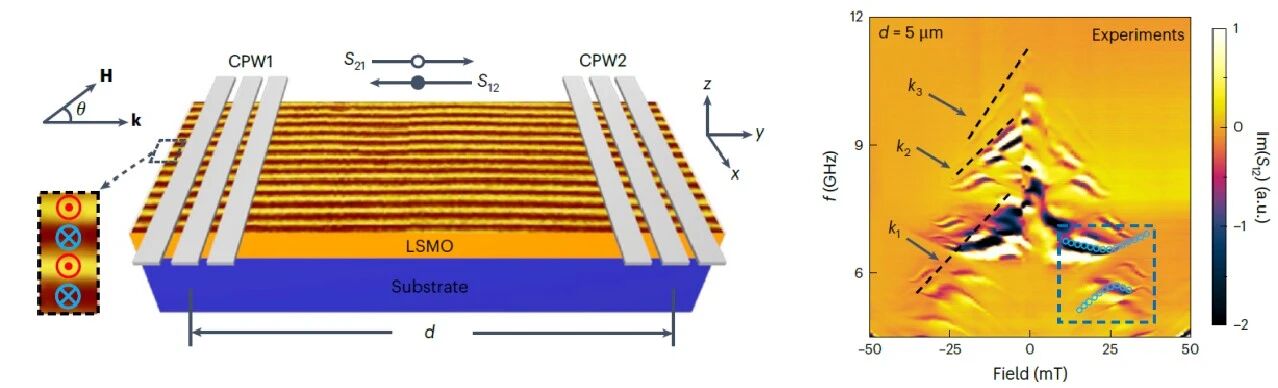
Figure 2. Nonreciprocal optical magnon modes observed under dynamic dipolar interactions.
This achievement represents a breakthrough in the long-distance propagation of chiral magnonic edge states, demonstrating substantial potential for future applications in quantum information processing and spintronics. The research team plans to further optimize thin-film fabrication processes and experimental parameters to enhance the propagation length and stability of chiral edge states, as well as to explore more efficient methods for magnon control and manipulation. Future studies will focus on realizing broader chiral magnon transport in more complex magnetic structures, providing new directions for the development of spin-wave-based quantum computing and information storage technologies.
The co–first authors of this work are Assistant Professor Yuelin Zhang (Beijing Normal University; formerly a visiting scholar at IQA), Lei Qiu (PhD student, Beijing Normal University), Associate Researcher Jilei Chen, and Associate Professor Shizhe Wu (Tiangong University). The corresponding authors are Professor Jinxing Zhang and Professor Ka Shen (Beijing Normal University), and Professor Haiming Yu (Beihang University). This work was supported by the National Key R&D Program of China, the National Natural Science Foundation of China, the Department of Science and Technology of Guangdong Province, Southern University of Science and Technology, and other agencies.
Link to the original paper::https://www.nature.com/articles/s41563-024-02065-x