
中文
中文
Recently, the research group led by Prof. Jilei Chen at the International Quantum Academy, Assistant Researcher Jinlong Wang, collaborated with Prof. Rembert A. Duine’s group at Utrecht University (Netherlands), Prof. Pietro Gambardella’s group at ETH Zurich (Switzerland), and Prof. Haiming Yu’s group at Beihang University. The team achieved important innovative results in the study of zero-field magnon switching in chiral spin-frustrated states.
The researchers demonstrated magnon-induced switching of chiral spin-frustrated states in bismuth-doped yttrium iron garnet (BiYIG) thin films, providing a new route for manipulating spin-frustrated states using magnons. This work was published in Physical Review Letters under the title “Observation and Control of Chiral Spin Frustration in BiYIG Thin Films” (DOI: 10.1103/wjvv-lp7n).
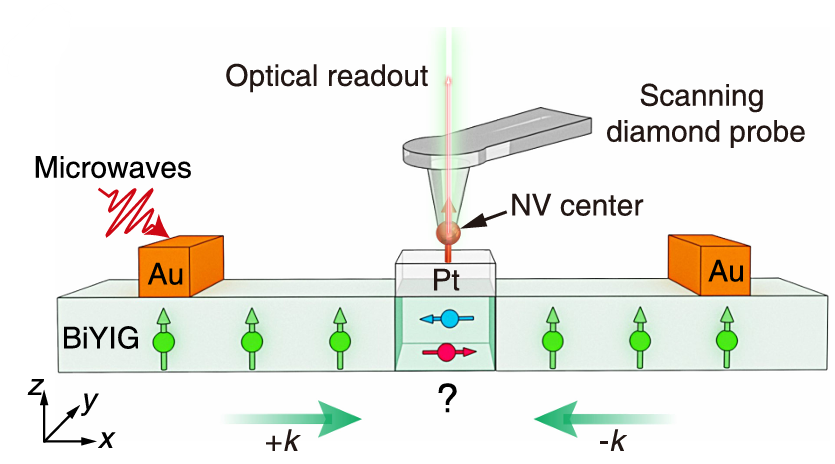
Figure 1. Schematic illustration of chiral spin frustration and NV-center detection.
Spin frustration refers to a class of materials in which competing exchange interactions cannot be simultaneously satisfied, resulting in multiple highly degenerate ground states. In conventional magnetic materials, frustration typically originates from geometric effects. For example, in a triangular lattice with antiferromagnetic interactions, spins cannot simultaneously satisfy all nearest-neighbor antiparallel alignments, leading to multiple energetically degenerate ground states.
In this work, chiral spin frustration is introduced. Unlike conventional frustration, this type of frustrated state originates from the Dzyaloshinskii–Moriya interaction (DMI) and does not require noncollinear spatial structures. The chiral spin-frustrated structure in BiYIG was confirmed using nonlocal spin pumping and nitrogen-vacancy (NV) center techniques. On this basis, the researchers demonstrated for the first time that different spin-frustrated states can be switched via propagating magnons under zero magnetic field.
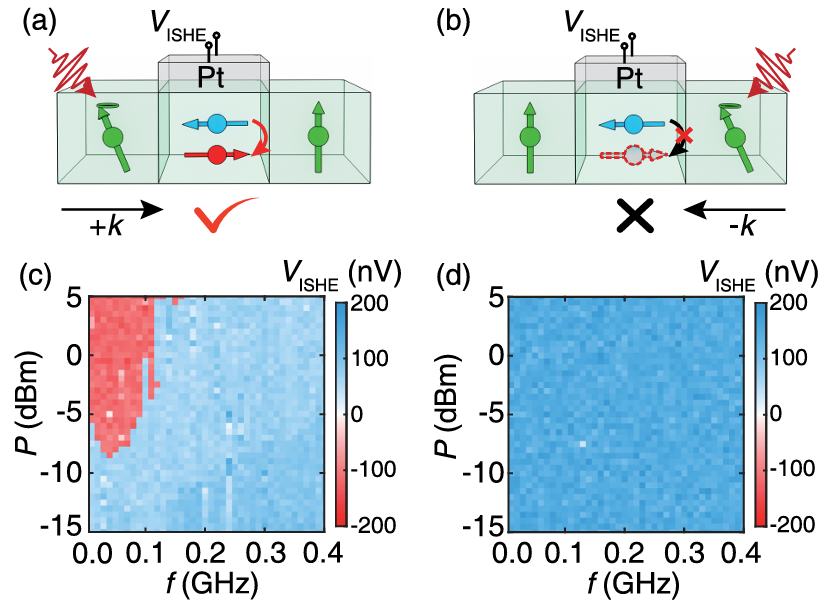
Figure 2. (a) Effective switching schematic when magnons are injected from the left (+k). (b) Ineffective switching schematic when magnons are injected from the right (−k). (c) Frequency and power spectrum of +k magnon excitation. In the configuration shown in (a), magnons injected from the left switch the frustrated state from ULU to DLD, where the color represents the sign of the inverse spin Hall voltage. (d) Frequency and power spectrum of −k magnon excitation. In the configuration shown in (b), magnons injected from the right leave the frustrated state unchanged.
Furthermore, the switching process exhibits strong unidirectionality: whether switching occurs depends on the direction of the injected magnon current. The switching outcome can be characterized by the inverse spin Hall effect (ISHE) voltage. Experimentally, magnon-mediated transitions between frustrated states show strict direction-locking behavior. When +k magnons are injected from the left antenna, the frustrated state can be switched; however, −k magnons injected from the right antenna cannot trigger the transition. This asymmetry originates from the matching between the DMI-induced torque and the magnon propagation direction.
This work provides the first experimental observation and confirmation of the novel physical phenomenon of “chiral spin frustration” in BiYIG, breaking the traditional dependence of frustration on geometric structures. By successfully integrating chiral interactions, spin frustration, and magnon transport, this work opens a new pathway toward next-generation magnon-based, low-power, high-performance information processing devices.
The first authors of this work are Assistant Researcher Jinlong Wang (International Quantum Academy), PhD candidate Hanchen Wang (ETH Zurich, former visiting student at the Institute), PhD candidate Zhewen Xu (ETH Zurich), and PhD candidate Artim L. Bassant (Utrecht University). The corresponding authors are Prof. Rembert A. Duine (Utrecht University), Prof. Pietro Gambardella (ETH Zurich), and Prof. Haiming Yu (Beihang University). This work was supported by the National Key R&D Program of China, the National Natural Science Foundation of China, and other funding agencies.
Paper Link: https://doi.org/10.1103/wjvv-lp7n