
中文
中文
Recently, under the leadership of Academician Yu Dapeng, Niu Jingjing and Zhong Youpeng from the Superconducting Quantum Computing Team at the Shenzhen International Quantum Academy, in collaboration with Miao Jianjian from The Chinese University of Hong Kong, achieved significant experimental progress in the field of synthetic dimensional quantum simulation. The research team successfully constructed multidimensional synthetic Fock state lattices (FSLs) using superconducting quantum circuits and demonstrated the Aharonov-Bohm (AB) caging effect from 2D to 3D. This accomplishment not only provides a feasible scheme for manipulating quantum states in high-dimensional synthetic spaces, but also opens new avenues for future studies of quantum many-body physics and topological phenomena in higher-dimensional quantum systems. The related findings were published online in the international academic journal Physical Review Letters on February 19, 2025, under the title “Synthetic Multidimensional Aharonov-Bohm Cages in Fock State Lattices.”
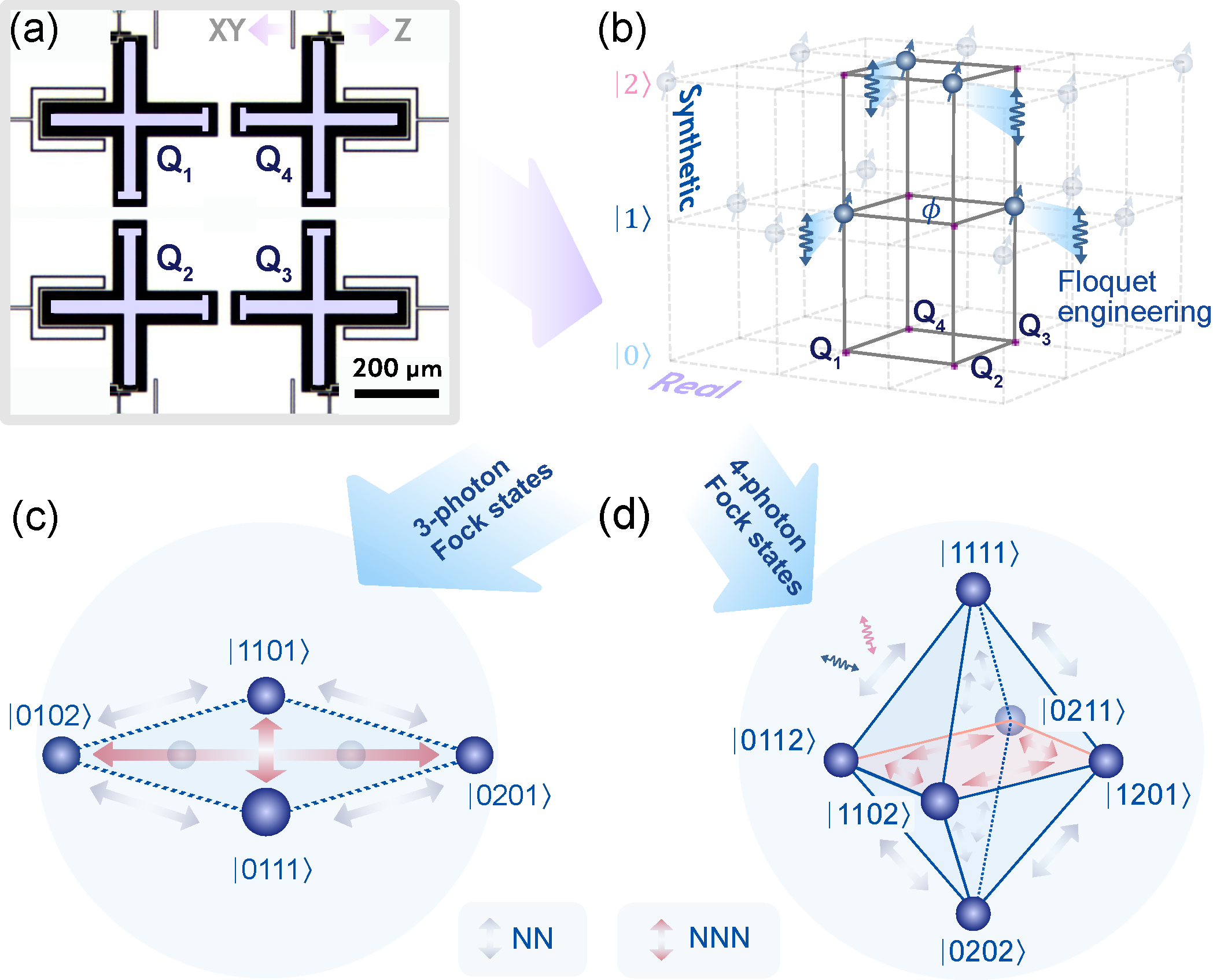
High-dimensional quantum systems constitute a significant frontier in condensed matter physics. Conventional quantum systems are mostly confined to low-dimensional spaces, whereas high-dimensional quantum systems can exhibit richer physical phenomena and broader application prospects. However, constructing and manipulating high-dimensional quantum systems in the laboratory has long posed substantial technical challenges. In recent years, the concept of synthetic dimensions has gradually emerged. By reinterpreting the degrees of freedom of a quantum system as additional spatial dimensions, researchers have successfully broken through the constraints of traditional physical space. This approach offers a new perspective for simulating high-dimensional quantum physics on low-dimensional experimental platforms. Moreover, effectively controlling the behavior of quantum states in high-dimensional space is the first step toward studying high-dimensional quantum systems. Therefore, key foundational issues for leveraging quantum platforms to study high-dimensional systems include how to construct high-dimensional symmetries in low-dimensional quantum devices and how to effectively regulate the transitions of quantum states along multiple pathways with limited degrees of freedom.
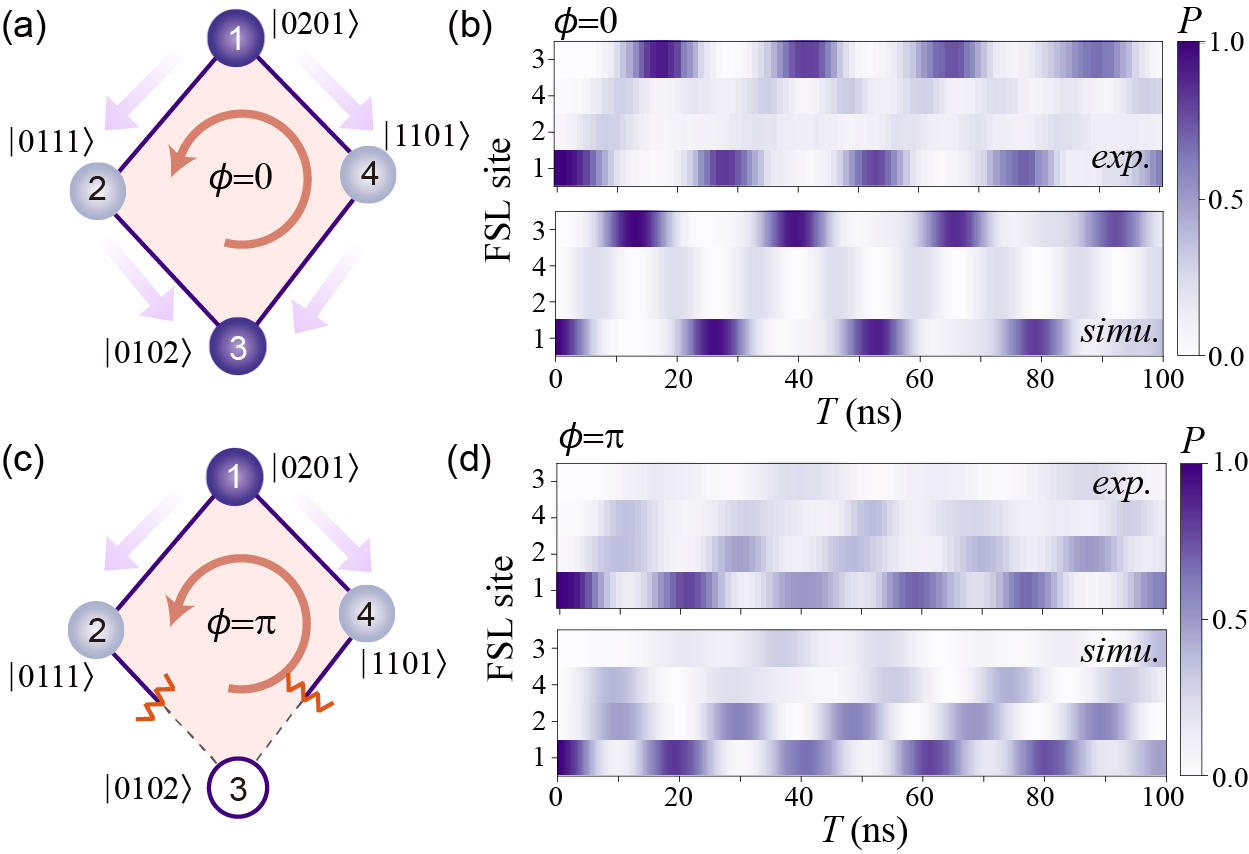
In this study, the research team adopted an innovative approach to successfully construct multidimensional Fock state lattices in a superconducting quantum circuit and demonstrated precise manipulation of quantum states. The Fock state lattice, constructed from photon number states with infinite Hilbert space, is suitable for simulating high-dimensional physics. To achieve this, the researchers first precisely prepared low-dimensionally arranged superconducting qubits into specific states. By rapidly modulating their frequencies, they brought different multiphoton number states into resonance, thereby constructing a Fock state lattice with high-dimensional symmetry. Within the Fock state lattice, interactions between lattice sites are no longer limited to nearest-neighbor interactions in low-dimensional physical space. Fock states with high photon numbers can give rise to rich multi-directional interactions, increasing the lattice coordination number and thus establishing high-dimensional symmetry. By jointly modulating the interaction phases among multiple sets of physical qubits, the researchers equivalently controlled the artificial gauge field within the synthetic Fock state lattice structure. They successfully observed the controlled walk of quantum superposition states on the multidimensional Fock state lattice and their localization within specific subspaces, ultimately realizing the AB caging effect from 2D to 3D and proposing a scheme for further extension to even higher dimensions.
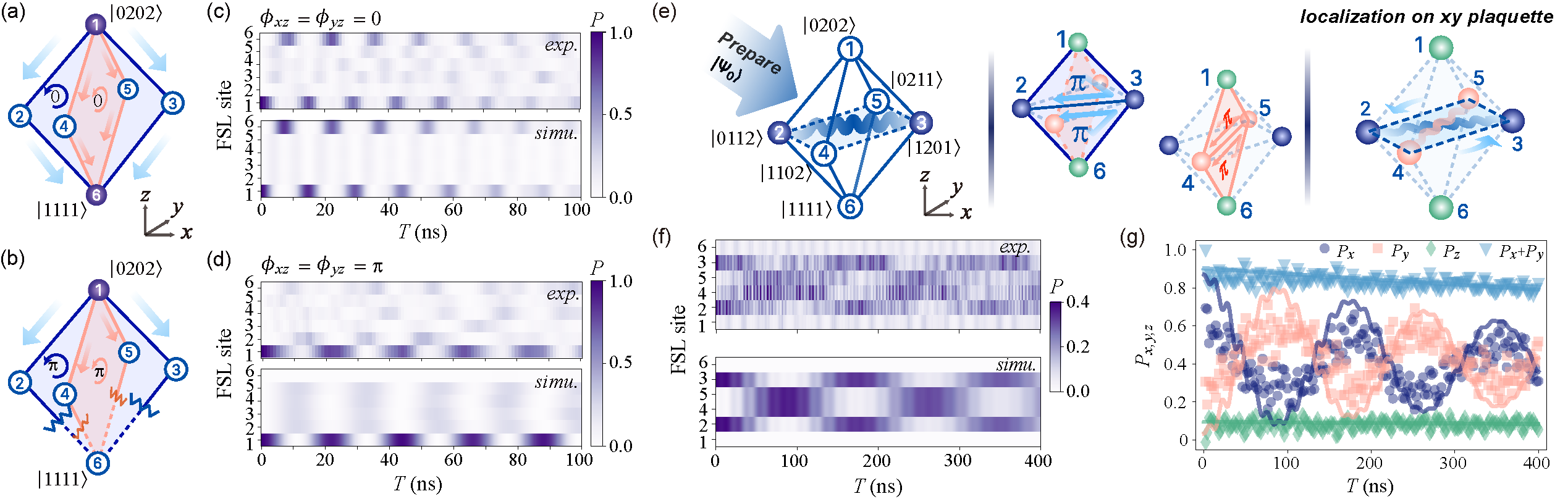
During the experiments, the team first realized AB caging in a 2D lattice, then extended the concept to 3D by incorporating two perpendicular rhombic plaquettes to form a 3D octahedral Fock state lattice. Utilizing Floquet engineering, the researchers synthesized an artificial gauge field, precisely controlling the phases accumulated by quantum states along different paths, thereby achieving controllable quantum interference. On this basis, they successfully observed quantum state localization phenomena in three-dimensional space. Furthermore, the research team demonstrated how to extend this method to a 3D superlattice, preparing entanglement between distant lattice sites, and using tunable couplers to achieve more complex gauge field control, thereby constructing coherently localized subspaces on the superlattice.
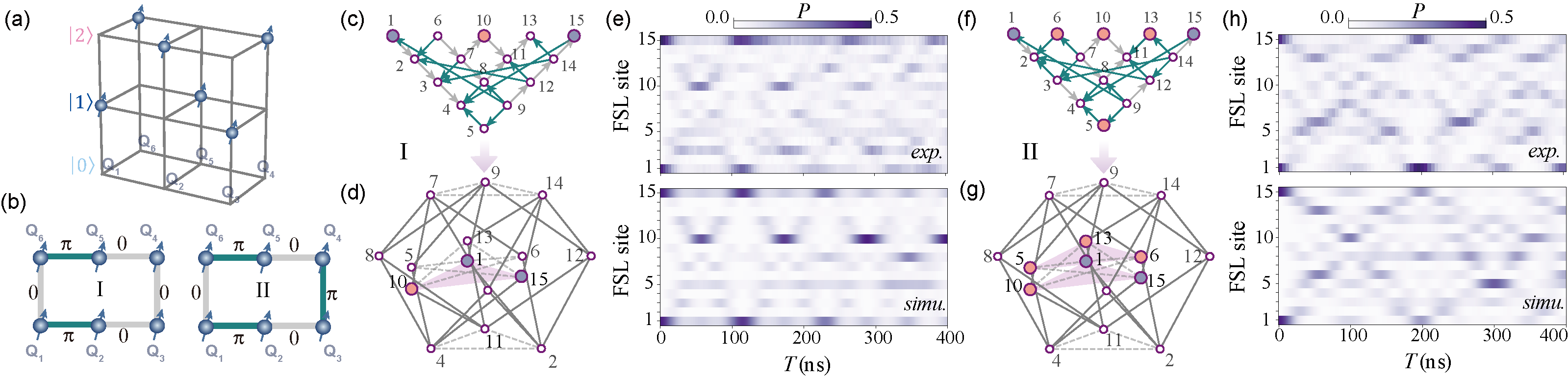
This research not only theoretically expands the understanding of high-dimensional quantum systems but also provides new tools and methods for experimentally studying high-dimensional quantum physics in the future. Moreover, as this method extends to higher-dimensional superlattices, it lays a technical foundation for building more complex high-dimensional quantum simulators.
In this work, PhD students Zhang Jiajian and Huang Wenhui from the Shenzhen International Quantum Academy are co-first authors of the paper. Zhong Youpeng, Miao Jianjian, and Niu Jingjing are corresponding authors, and Academician Yu Dapeng is the last author. The Shenzhen International Quantum Academy is the first affiliation. This research received strong support from the Department of Science and Technology of Guangdong Province, the Shenzhen Science, Technology and Innovation Commission, the National Natural Science Foundation of China, Hefei National Laboratory, and other institutions.
Paper Link: https://doi.org/10.1103/PhysRevLett.134.070601