
中文
中文
Recently, the research team led by Professor Dapeng Yu from the Shenzhen International Quantum Academy, in collaboration with the team led by Professor Luming Duan from Tsinghua University, has achieved significant experimental progress in superconducting quantum network research. The team successfully established a 64-meter-long, low-loss quantum channel between superconducting quantum chips, enabling high-quality long-distance quantum state transmission and remote entanglement generation based on microwave flying photons. For the first time, they experimentally demonstrated remote quantum state and quantum gate teleportation across superconducting chips. This research presents a feasible scheme for building long-distance microwave quantum networks using superconducting quantum circuits, demonstrates a prime building block for distributed quantum computation with superconducting qubits. The related research results have been published on Science Bulletin under the title "Deterministic quantum state and gate teleportation between distant superconducting chips."
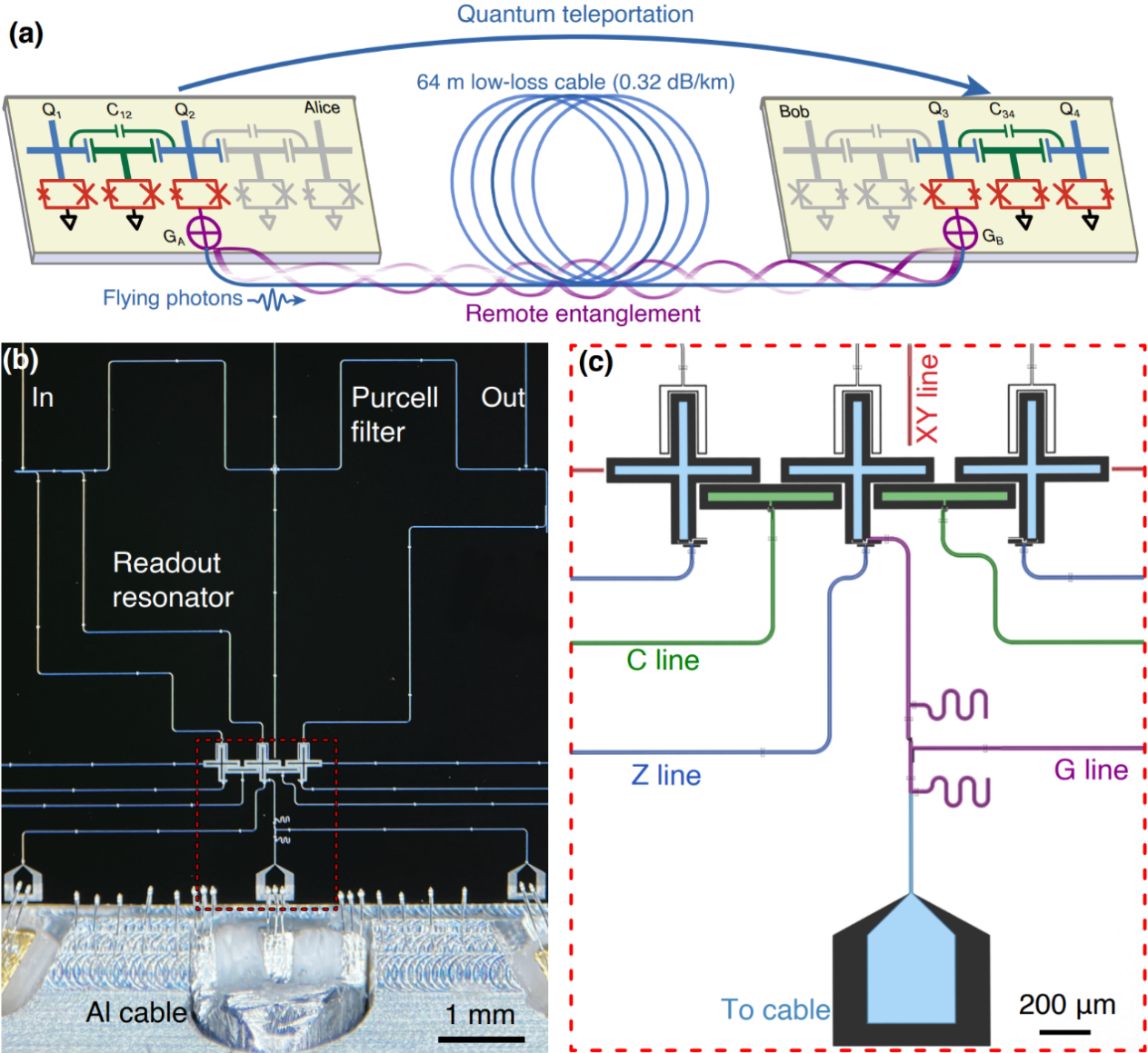
Figure 1: Overview of the experiment and chip structure. Two chips are connected by a 64m-long superconducting microwave coaxial cable, achieving long-distance entanglement generation and quantum teleportation.
Quantum teleportation technology can transmit quantum states using remote entanglement without moving the physical object itself, holding profound theoretical value and broad practical application prospects. Although teleportation has been previously achieved in optical and trapped-ion systems, superconducting quantum circuits have been limited by chip interconnect performance, and prior experiments were restricted to demonstrations within a single chip or between closely spaced modules.
In this study, the researchers overcame the technical bottleneck of high-fidelity long-distance inter-chip connections in superconducting quantum chips by constructing a superconducting microwave transmission channel up to 64 meters long with loss as low as 0.32 dB/km, enabling efficient transmission of flying microwave photons. The team employed tunable couplers to shape and capture the flying photons and developed an in-situ calibration method for control waveforms, successfully preparing remote entangled pairs with a fidelity of 94.2%, setting a new experimental record in this direction.
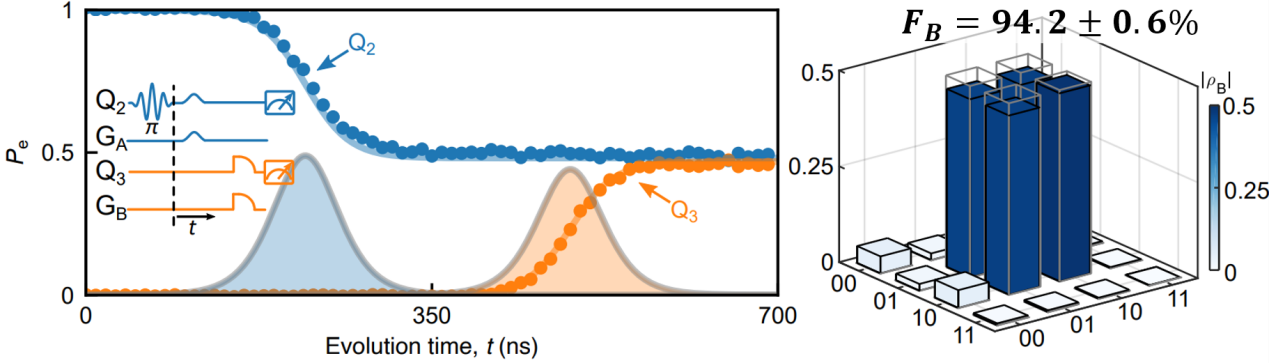
Figure 2: Generation of high-fidelity remote quantum entanglement. Calibrated control pulses shape symmetric microwave photon wave packets, which are transmitted across chips between two qubits, ultimately generating an entangled state.
Building on this foundation, the researchers further achieved deterministic quantum state teleportation with an average process fidelity of 78.3%, significantly surpassing the classical limit of 1/2. Additionally, using a quantum-gate teleportation protocol, the team implemented a deterministic remote CNOT gate between chips with a process fidelity of 70.2%. This represents the first remote quantum teleportation experiment across superconducting quantum chips, establishing a key building block for superconducting quantum networks and distributed superconducting quantum computing.
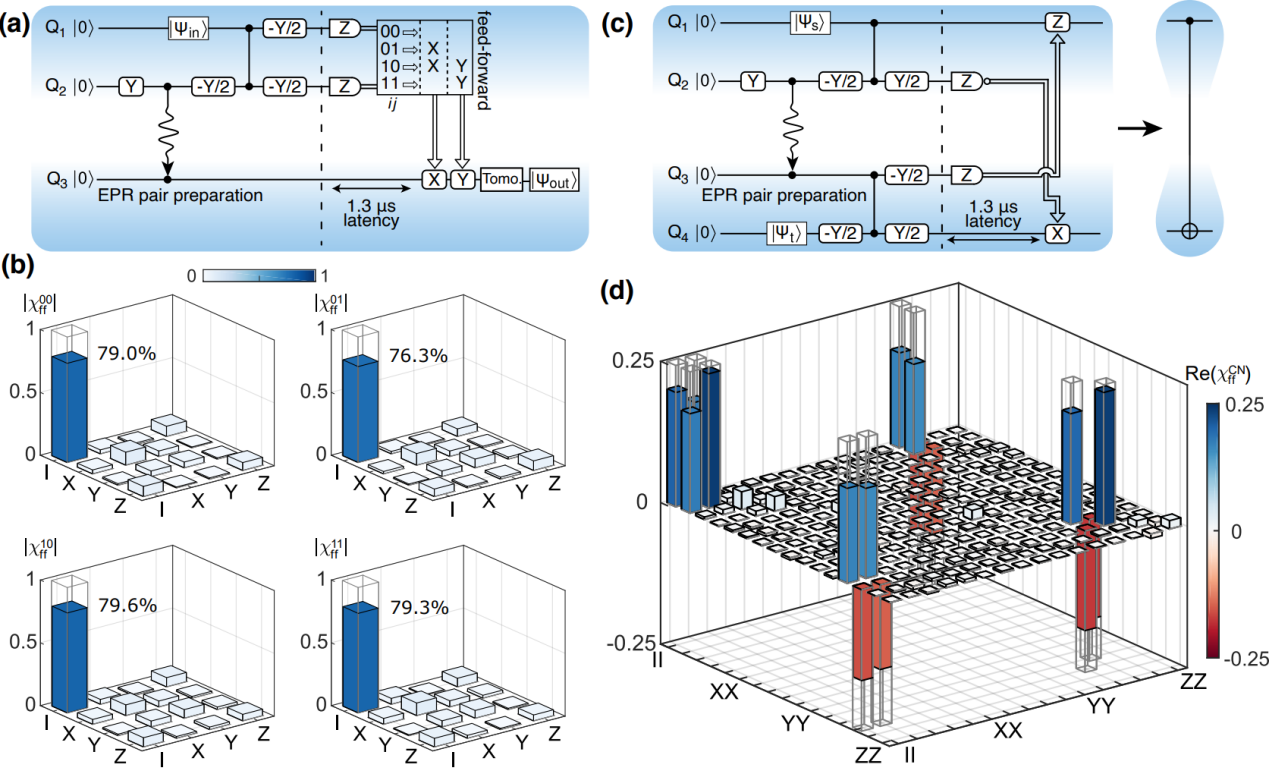
Figure 3: Quantum state teleportation and quantum gate teleportation, with their respective quantum circuits and process matrices.
This work explores a viable path for building superconducting quantum networks across chips and cryostats, marking an important step toward scaling superconducting quantum computing through distributed architectures. Furthermore, the low-loss microwave quantum channel demonstrated in this research also provides an ideal experimental platform for waveguide quantum electrodynamics and microwave quantum optics experiments.
In this work, Jiawei Qiu, Yang Liu, and Ling Hu from the International Quantum Academy are co-first authors of the paper. Song Liu, Youpeng Zhong, Luming Duan, and Dapeng Yu are the corresponding authors. This research was supported by the Guangdong Provincial Department of Science and Technology, the Shenzhen Science and Innovation Bureau, and the National Natural Science Foundation of China.
Paper Link:https://doi.org/10.1103/PhysRevLett.134.070601