
中文
中文
Recently, under the leadership of Academician Dapeng Yu, the research team led by Researcher Yuan Xu at the Shenzhen International Quantum Academy, in collaboration with a research group including Professor Changling Zou from the University of Science and Technology of China (USTC), has achieved a major experimental breakthrough in quantum precision measurement based on superconducting quantum circuit systems. The joint team overcame significant challenges and successfully prepared the Fock states containing up to 100 photons within a high-quality-factor superconducting microwave cavity. Building on this, they realized a quantum-enhanced precision measurement technique that approaches the Heisenberg limit. This work demonstrates the advantages of large-photon-number Fock states for high-precision quantum sensing and paves a new path for the development of high-accuracy quantum metrology. The related research, titled "Quantum-enhanced metrology with large Fock states" was published online in the prestigious international journal Nature Physics on August 20, 2024.
From ancient times to the present, humanity has continuously explored and sought to understand the physical world, in which precision measurement has played a crucial role. It is fair to say that the entire edifice of modern natural science has been built upon the steady advancement of measurement accuracy. The pursuit of ever-higher measurement precision has remained a persistent goal of human endeavor. In turn, developments in sensing have provided robust support for scientific research, engineering technology, and daily life.
However, classical sensing are constrained by the standard quantum limit, making further enhancement of their accuracy inherently difficult. Quantum mechanics offers the potential to surpass this limit. In principle, measurement precision under a quantum framework can reach the ultimate bound allowed by quantum mechanics—the Heisenberg limit. Compared to the standard quantum limit, the achievable gain in precision scales with the square root of the number of particles in the system. Yet, in practical applications, reaching the Heisenberg limit remains a significant experimental challenge, primarily due to the difficulty in effectively controlling and measuring large-scale non-classical quantum states.
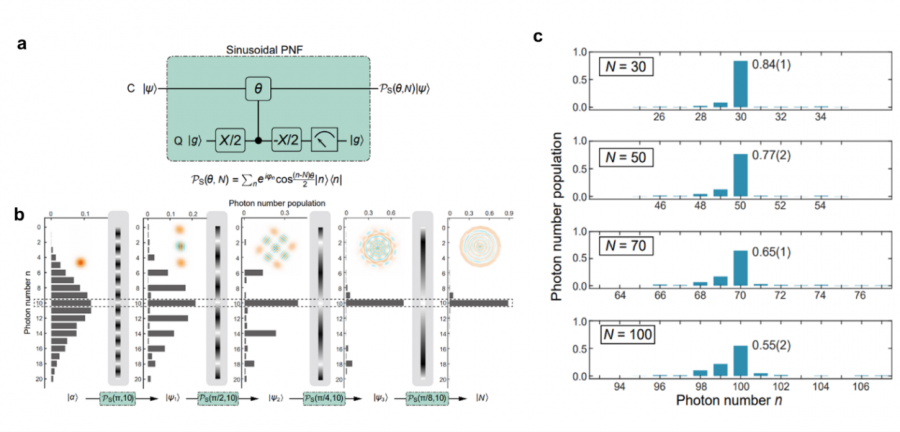
Fig.1 a. Quantum circuit diagram of the photon-number filter. b. Example of the quantum state preparation process. c. Preparation results of large-photon-number Fock states.
To address these challenges, the joint research team ingeniously utilized large-photon-number Fock states within a single harmonic oscillator, successfully achieving hardware-efficient, high-precision measurement that surpasses the standard quantum limit. In this work, researchers developed an efficient method for generating Fock states containing up to 100 photons within a superconducting microwave cavity through the development of a programmable photon number filter. Using these highly nontrivial states for measuring small displacements and phases of the electromagnetic field in the cavity, they demonstrated quantum-enhanced metrology approaching the Heisenberg scaling and achieve a maximum metrological gain of up to 14.8 decibels, highlighting the metrological advantages of large Fock states.
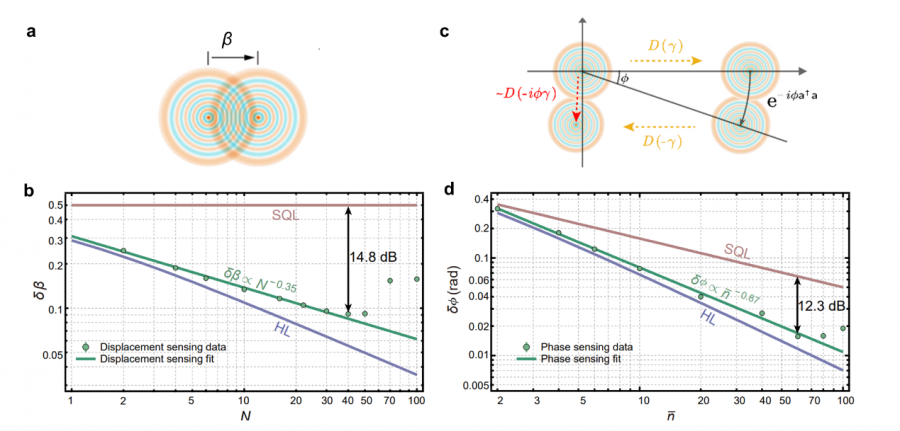
Fig. 2. Schematics and experimental results of quantum-enhanced metrology for microwave field displacement (a, b) and phase (c, d).
In this study, Assistant Researcher Xiaowei Deng and visiting student Sai Li (Shenzhen International Quantum Academy) and Ph.D. Zijie Chen (USTC) contributed equally as co first authors. Researcher Yuan Xu from the Shenzhen International Quantum Academy and Professor Changling Zou from USTC are corresponding authors, with Academician Dapeng Yu as the senior corresponding author. Other collaborators include Associate Researcher Song Liu and Assistant Researcher Pan Zheng from the Shenzhen International Quantum Academy, as well as Researcher Haifeng Yu from the Beijing Academy of Quantum Information Sciences. The Shenzhen International Quantum Academy is the primary affiliation for this research. The work was supported by the Department of Science and Technology of Guangdong Province, the Shenzhen Science and Technology Innovation Commission, the National Natural Science Foundation of China, the Hefei National Laboratory, and other institutions.
Paper Link:https://www.nature.com/articles/s41567-024-02619-5