
中文
中文
Recently, the research team led by Researcher Yuan Xu and Academician Dapeng Yu at the Shenzhen International Quantum Academy made a significant experimental breakthrough in the field of quantum squeezing control and quantum sensing. In a superconducting quantum circuit system, the team developed an efficient quantum control method using the weak Kerr nonlinearity, deterministically realizing quantum squeezing amplification and achieving a maximum squeezing degree of 14.6 dB and a squeezing rate of 0.28 MHz. Building on this, they employed the highly squeezed quantum state to demonstrate high-precision quantum sensing of microwave displacement signals, surpassing the standard quantum limit by 9.3 dB. The related findings have been published in the high-impact international journal Nature Communications under the title “Quantum squeezing amplification with a weak Kerr nonlinear oscillator.”
In the quantum world, the precision of sensing performed using classical resources is bounded by the “standard quantum limit” imposed by vacuum fluctuations. The quantum squeezed state is a type of nonclassical quantum state whose key feature is the asymmetric redistribution of quantum noise in a pair of conjugate observables, such as position and momentum. Under the constraint of the Heisenberg uncertainty principle, the noise in one observable can be reduced below the standard quantum limit while the noise in the conjugate observable increases. This property makes squeezed states a crucial resource for quantum sensing.
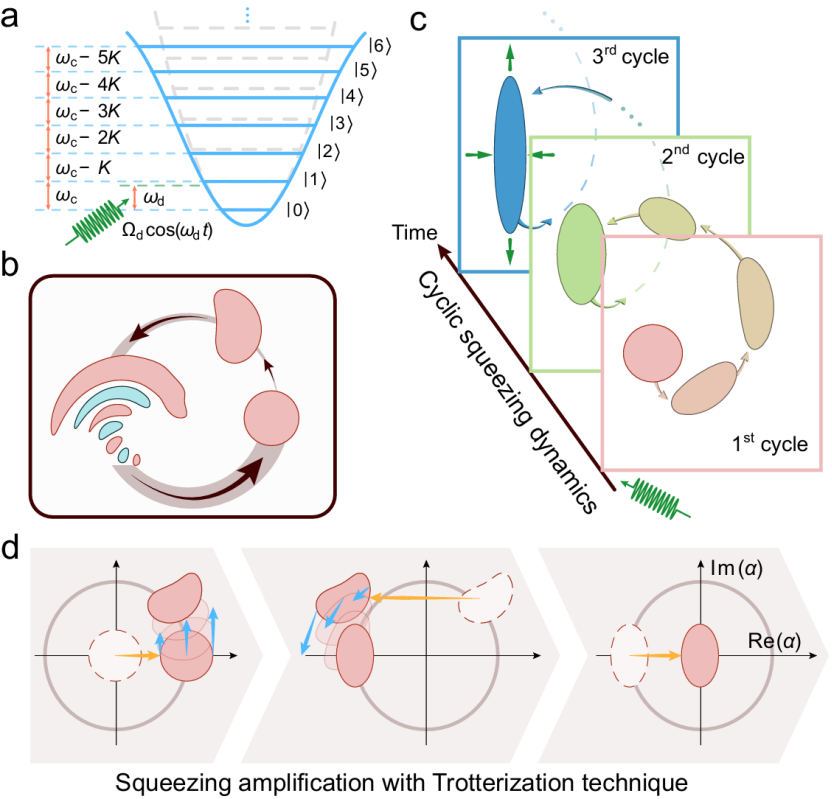
Fig. 1. Schematic illustration for achieving quantum squeezing amplification with a Kerr nonlinear oscillator.
However, achieving a high degree of squeezing typically requires strong nonlinear effects, which inevitably introduce additional decoherence and limit the ability of linear drives to access large Hilbert spaces. To address this challenge, the research team adopted an alternative approach. Using a superconducting microwave resonator with weak Kerr nonlinearity, they achieved deterministic squeezed-state generation and squeezing amplification by applying a detuned microwave drive and employing Trotterization techniques.
Specifically, in the displacement frame, the Hamiltonian of a weakly Kerr-nonlinear resonator under a detuned drive contains a squeezing term whose rate is amplified by a factor of |β|2, where β is the displacement amplitude. To eliminate other non-squeezing terms present in the Hamiltonian within this frame, the team carefully designed the parameters of the detuned drive. This ensures that the coherent state in the resonator does not collapse during evolution and instead undergoes periodic squeezing dynamics, with the squeezing level progressively increasing over successive evolution cycles.
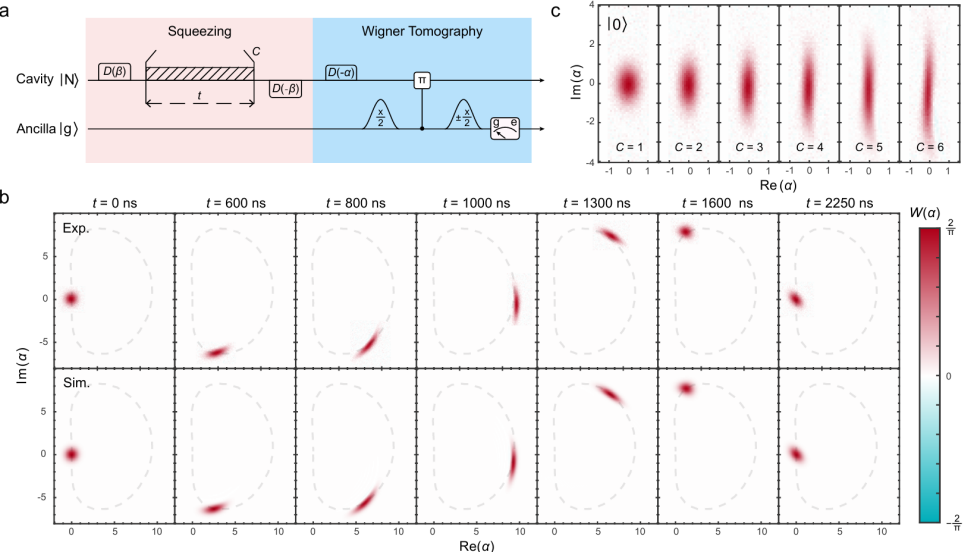
Fig. 2. Cyclic squeezing evolution with a detuned drive on the Kerr nonlinear oscillator for generating squeezed vacuum states.
Building on this, by employing Trotterization techniques, the research team utilized alternating displacement-frame transformations with opposite phases to more effectively eliminate the non-squeezing terms in the Hamiltonian under the displacement frame, thereby achieving superior squeezing performance. They successfully realized the deterministic preparation of a squeezed state with a maximum squeezing level of 14.6 dB—the highest squeezing degree experimentally achieved to date in a superconducting microwave three-dimensional resonator system.
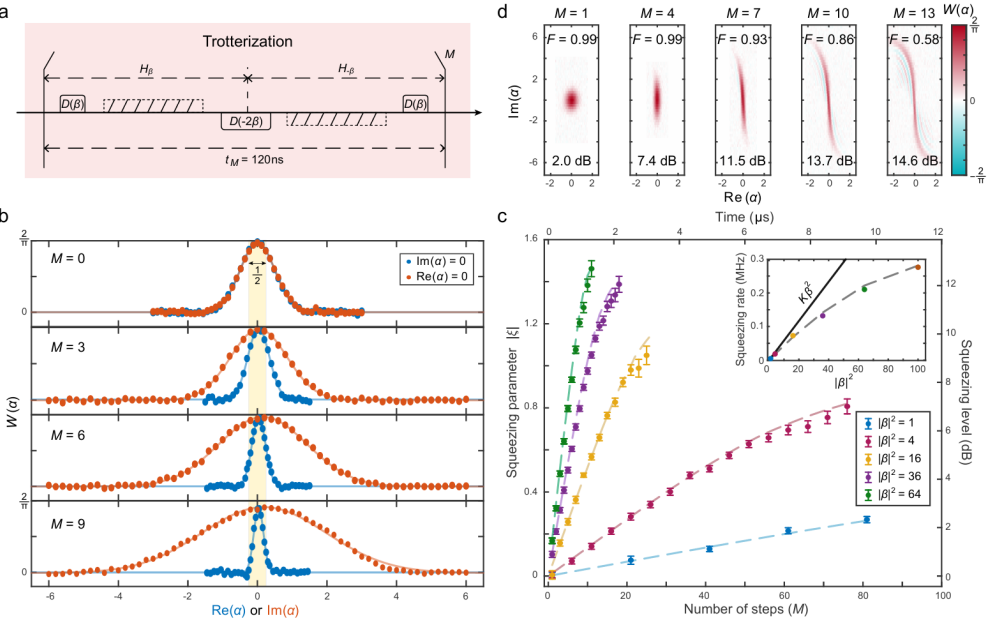
Fig. 3. Quantum squeezing amplification with the Trotterization technique.
Utilizing the experimentally prepared highly squeezed state as a resource, the research team conducted high-precision quantum sensing of the electromagnetic field displacement, achieving a measurement gain surpassing the standard quantum limit by up to 9.3 dB.
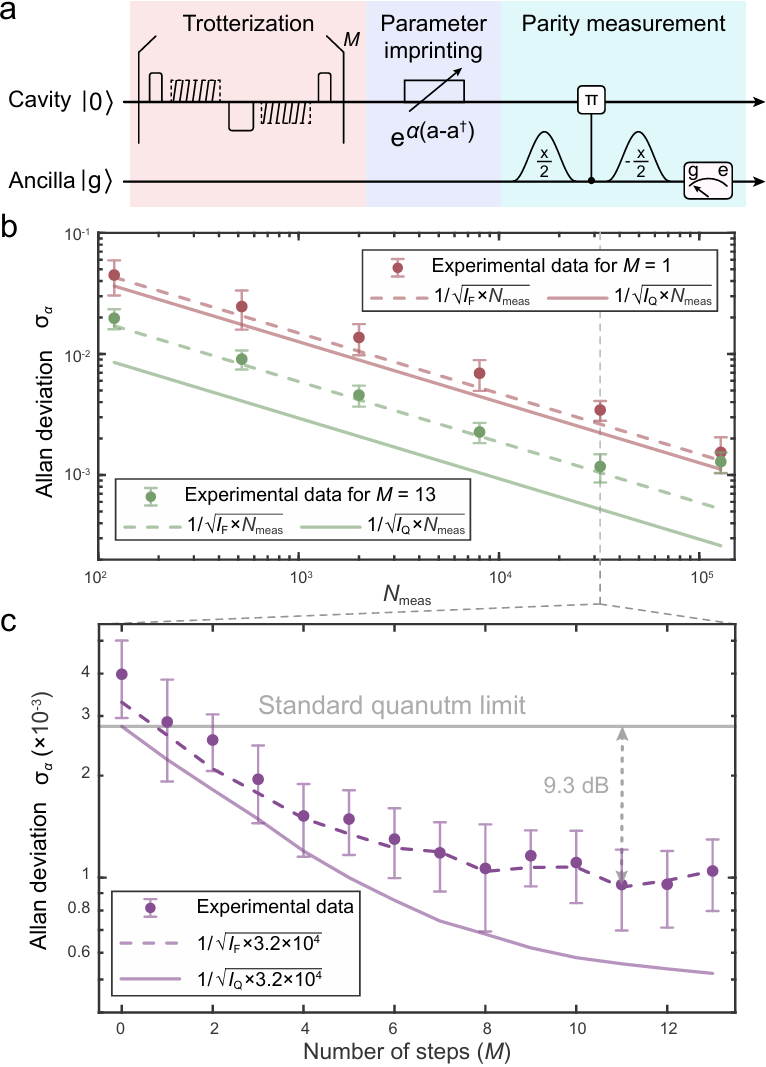
Fig. 4. Quantum metrology for measuring small displacements using the generated squeezed states.
In this research work, Yanyan Cai (Ph.D. candidate at SIQSE), Xiaowei Deng (associate researcher at SIQSE), and Libo Zhang (Ph.D. candidate at SIQSE) are co-first authors of the paper. Researcher Yuan Xu serves as the corresponding author, and Academician Dapeng Yu is the last author. The research received substantial support from the Department of Science and Technology of Guangdong Province, the Shenzhen Science and Technology Innovation Commission, the National Natural Science Foundation of China, Hefei National Laboratory, and other institutions.
Paper Link: https://doi.org/10.1038/s41467-025-67699-0