
中文
中文
A research team led by Prof. Yu He and Prof. Dapeng Yu at the Shenzhen International Quantum Academy has achieved a milestone in quantum error detection in silicon. For the first time, the team implemented error detection using stabilizers—a method compatible with fault-tolerant quantum computing—on a donor-based silicon quantum processor. The work also revealed the unique strongly biased noise characteristics inherent to the silicon spin qubit system. The related findings, entitled “Quantum error detection in a silicon quantum processor” have been published in Nature Electronics on 26th Jan, 2026.
Detecting and correcting quantum errors is essential for building large-scale, fault-tolerant quantum computation (FTQC). Silicon spin qubits are a leading platform due to their compatibility with semiconductor manufacturing, long coherence times, and scalability. Recent progress includes high-fidelity readout, fault-tolerant quantum gates, and integrated prototype demonstrations, as well as qubit operation above one Kelvin. Although previous work demonstrated phase-flip error correction with three-qubit, stabilizer-based quantum error detection—a method compatible with fault-tolerant architectures such as the surface code—had not yet been realized in silicon.
In this work, the donor atom quantum processor (Fig. 1a) is fabricated using the scanning tunneling microscope (STM) hydrogen lithography. The device includes a single-electron transistor (SET) for spin readout; three quantum dots composed of clusters of phosphorus atoms, and in-plane gates to control the relative chemical potential between the SET and the dots. One of the quantum dots, consisting of five phosphorus nuclei and one nearby hydrogen nucleus, was used to run the quantum circuits. In the experiment, four phosphorus nuclear spins and one electron spin were employed, while the remaining two nuclear spins were set to a fixed spin state to mitigate uncontrolled dynamics and crosstalk. On-chip microwave antennas enabled separate control of the electron and nuclear spins via electron spin resonance (ESR) and nuclear magnetic resonance (NMR) pulses.
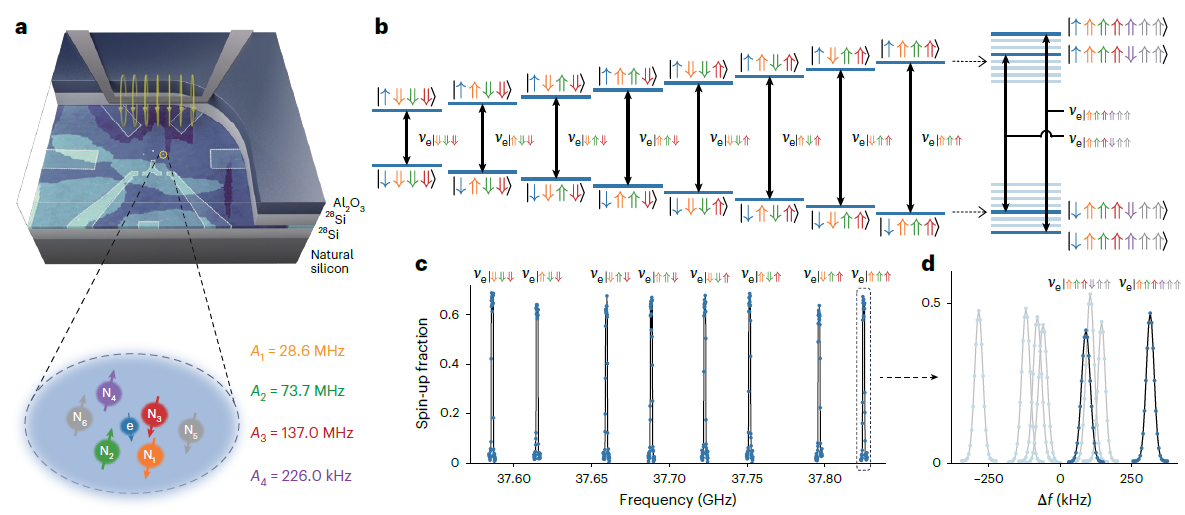
Figure 1. Schematic illustration of the experimental device, fabricated using STM hydrogen lithography, and Energy levels and corresponding ESR transitions conditioned on specific nuclear spin configurations.
This work demonstrates a highly integrated donor-based silicon quantum processor. The processor achieved high-fidelity gate operations: 99.57% for single-qubit Clifford gates and 97.76% for two-qubit CZ gates. A key feature is the use of a shared electron spin to mediate interactions between nuclear spins, enabling a native multi-qubit CCCZ gate that functions as a fast geometric phase gate. Utilizing this gate, the team constructed a four-qubit Toffoli gate with a population transfer fidelity of 95.9%, providing an efficient tool for executing complex quantum algorithms. With this high-connectivity architecture, they generated Bell entangled states between every pair of nuclear spin combinations with an average fidelity of 93.4% and prepared a four-qubit Greenberger–Horne–Zeilinger (GHZ) state with a fidelity of 88.5% fidelity, demonstrating the processor's capability to generate and manipulate multi-qubit entanglement.
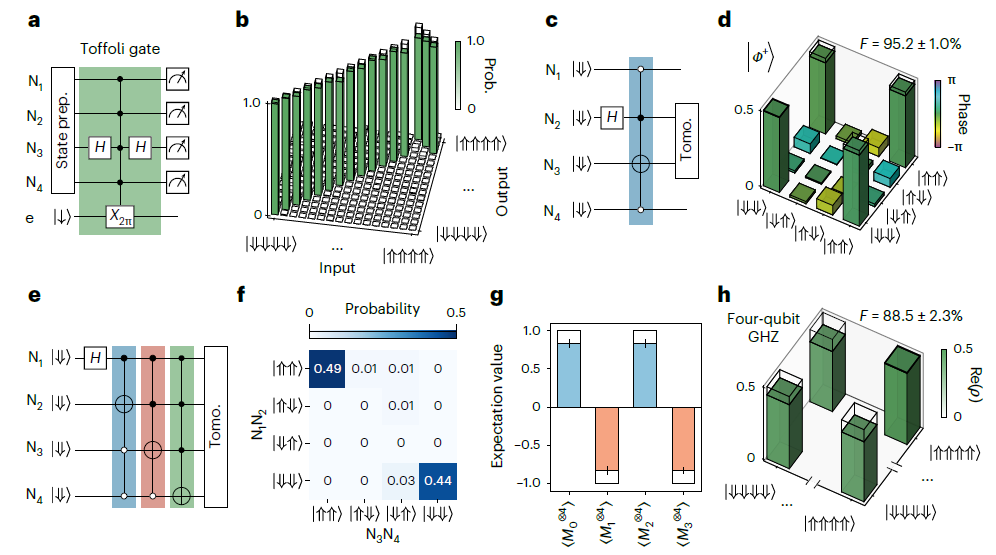
Figure 2. The implementation of the Toffoli gate, the preparation of Bell states, and the four-qubit GHZ state.
Using a tailored four-qubit error detection circuit implementing a [[2,0,2]] code, the team employed two stabilizers (SX = XX and SZ = ZZ) to detect arbitrary single-qubit errors via quantum non-demolition (QND) measurements. Through Pauli-frame update (PFU) post-processing based on the stabilizer measurements, they recovered the encoded Bell state entanglement with a fidelity of 79.0%, without post-selection. Furthermore, by introducing a controlled decoherence time before detecting and correcting errors, they showed that entanglement could be restored even after the qubits had dephased, confirming the effectiveness and robustness of the error detection approach in preserving quantum information.
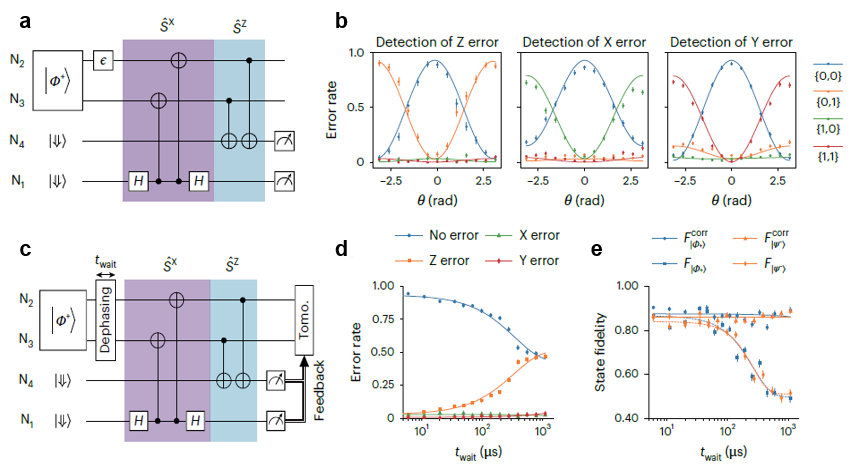
Figure 3. Arbitrary single-qubit error and the strongly biased noise detection using stabilizer measurements.
Notably, the team directly observed that the noise in the silicon qubit system is strongly biased: dephasing errors dominate, while relaxation errors are minimal. This behavior differs from other platforms like superconducting circuits. The finding provides key experimental evidence for designing efficient error-correcting codes optimized for silicon spin qubits.
The co-first authors are Chunhui Zhang, Chunhui Li (both PhD candidates), and Zhen Tian (Assistant Researcher) of the Shenzhen International Quantum Academy. Corresponding authors are Prof. Yu He, Prof. Dapeng Yu, Associate Researcher Guangchong Hu, and Associate Researcher Guanyong Wang. This work was supported by the National Natural Science Foundation of China, Hefei National Laboratory, Shenzhen Science and Technology Program, and Guangdong Basic and Applied Basic Research Foundation.
Paper link: https://www.nature.com/articles/s41928-025-01557-1