
中文
中文
Recently, Associate Researcher Zhengda Li from the Shenzhen International Quantum Academy (IQASZ) , Professor Jingyun Fan from the Department of Physics and SIQSE, SUSTech, in collaboration with Professor Mingxing Luo from the School of Information Science and Technology at Southwest Jiaotong University, have made significant theoretical and experimental progress in the field of entanglement-based quantum network verification and topology classification. The research team conducted, for the first time, a theoretical and experimental investigation into the nonlocality and network topology discrimination of different types of triangle quantum networks, revealing the fundamental quantum properties of the basic building blocks of quantum networks. This work represents an experimental research precedent for studying the fundamental structure of quantum networks. The related findings were published online in the academic journal Physical Review Letters on June 11, 2024, under the title "Certifying Network Topologies and Nonlocalities of Triangle Quantum Networks."
Quantum networks are poised to be the primary platform for future quantum information processing. Compared to traditional classical networks, quantum networks will drive innovation in information processing and communication, offering new possibilities for solving problems intractable by conventional computational methods. In recent years, integrated space-ground quantum secure communication networks have begun to take shape, and technologies for quantum network terminals—such as quantum computers, quantum sensors, quantum repeaters, and quantum communication terminals—have repeatedly achieved breakthroughs. Novel quantum network tasks, including blind quantum computation, multiparty quantum computation, quantum conferencing, and quantum secret sharing, are emerging continuously. Network topology and network nonlocality underpin various applications of quantum networks. Wiring entanglement sources and parties differently in a quantum network results in different network structures. Existing studies have not fully considered the nonlocality associated with specific network topologies, and related methods cannot reveal the network nonlocality linked to different topological configurations. Therefore, an open challenge is to design an experimental method capable of determining both the network topology and the network nonlocality of a quantum network.

Figure 1: Quantum Networks
The triangle quantum network is an ideal platform for studying quantum systems involving three parties, as illustrated in Figure 1. By sharing EPR entangled particle pairs or three-particle GHZ states among the participants, different network structures can be created, including quantum chain networks, quantum triangle networks, and GHZ networks, as shown in Figure 2. These network structures can exhibit distinct nonlocality characteristics, such as Bell nonlocality, chain-network nonlocality, triangle-network nonlocality, and full network nonlocality. By employing Bell-type methods, these network topologies and nonlocality features can be detected and characterized.
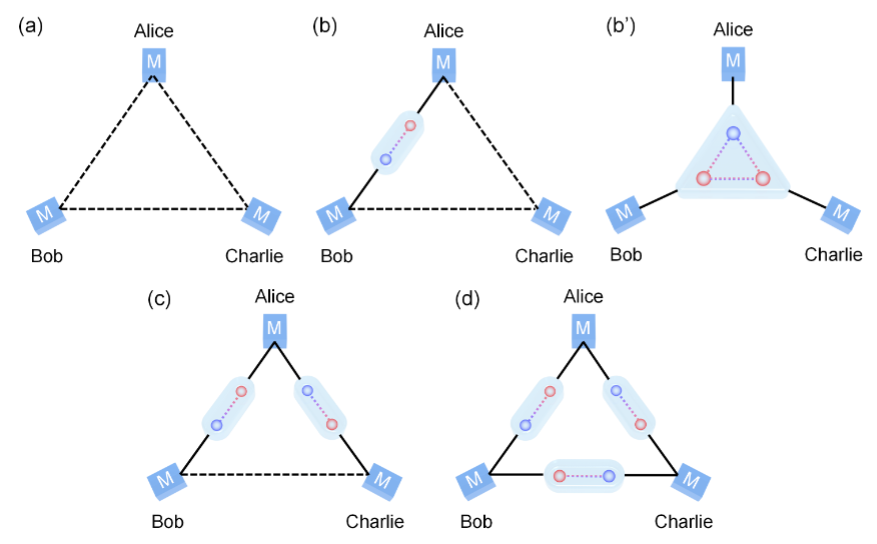
Figure 2: The Triangle Quantum Network
The researchers constructed a general Bell-type witness operator and experimentally demonstrated, for the first time, the determination of the network topologies and network nonlocalities hosted by triangle quantum networks through statistical measurements of outcome probabilities. We anticipate that this unique approach may stimulate further studies toward the efficient characterization of large complex quantum networks, thereby better harnessing the advantage of quantum networks for quantum information applications.
The corresponding authors are Professor Jingyun Fan (Department of Physics and SIQSE, SUSTech), Associate Researcher Zhengda Li (IQASZ), and Professor Mingxing Luo (School of Information Science and Technology, Southwest Jiaotong University). The Southern University of Science and Technology is the primary affiliation for this publication. This research received substantial support from the Guangdong Pearl River Talent Program (Leading Talents), Shenzhen Pengcheng Scholars Program, Key-Area Research and Development Program of Guangdong Province, Guangdong Pearl River Innovation and Entrepreneurship Team, National Natural Science Foundation of China, Guangdong Provincial Key Laboratory of Quantum Science and Engineering, Shenzhen Science and Technology Innovation Commission, SIQSE at SUSTech, as well as the Sichuan Provincial Department of Science and Technology and Southwest Jiaotong University.
Paper Link: https://doi.org/10.1103/PhysRevLett.132.240801