
中文
中文
Recently, a collaborative research team led by Professor Jingyun Fan from the Department of Physics, the Shenzhen Institute for Quantum Science and Engineering (SIQSE), and the Center for Advanced Light Source at the Southern University of Science and Technology (SUSTech), Associate Researcher Zhengda Li from IQASZ, together with researchers from Sun Yat-Sen University, has made significant progress in the field of non-Hermitian physics. The team experimentally observed the Non-Hermitian Edge Burst Effect (NHEBE), a phenomenon arising from the combined action of the non-Hermitian skin effect (NHSE) and the closing of the imaginary part of the energy band gap. The related research work, entitled "Observation of Non-Hermitian Edge Burst Effect in One-Dimensional Photonic Quantum Walk," has been published in the prestigious academic journal Physical Review Letters.
Non-Hermitian physics provides an efficient and intuitive description for dissipative quantum systems, revealing numerous intriguing phenomena beyond the Hermitian scenario. One particularly important phenomenon is the non-Hermitian skin effect (NHSE), which demonstrates the strong localization of bulk eigenstates towards the system boundary. This effect generalizes the bulk-boundary correspondence from Hermitian topological phases to non-Hermitian systems. The interplay of NHSE with other mechanisms leads to various novel dynamical behaviors, among which the Non-Hermitian Edge Burst Effect studied in this work is a prominent example.
The researchers focused on a one-dimensional finite-length non-Hermitian Su-Schrieffer-Heeger (SSH) lattice chain with uniform dissipation. When a particle is injected at an interior lattice site, it gradually dissipates into the surrounding environment during diffusion. Conventionally, one would expect the dissipation to be most significant near the injection site and weaken monotonically as the diffusion spreads farther away, presenting a decreasing trend from the injection site, through the bulk, to the boundary. However, theoretical studies indicated that the synergy between the non-Hermitian skin effect and the closing of the imaginary band gap could lead to a dramatic enhancement of dissipation precisely at the boundary.
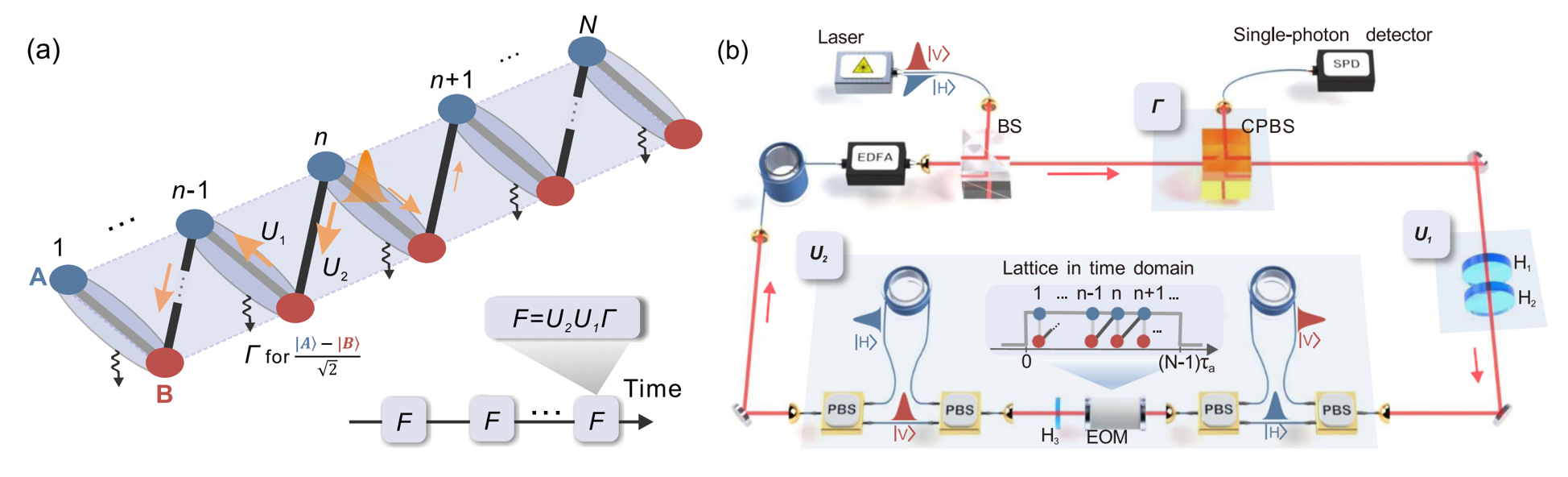
Figure 1: (a) Non-Hermitian SSH Model (b) Experimental Setup for Time-Domain Photonic Quantum Walk
The joint research team conducted experimental investigations on this problem. They effectively realized a one-dimensional finite-length non-Hermitian SSH lattice with uniform dissipation based on the time-domain photonic quantum walk method. Utilizing time-resolved single-photon detection technology, they performed real-time observations of particle diffusion within the lattice. By systematically tuning experimental parameters, they revealed the dissipative edge burst and its conditions, thereby confirming that its generation mechanism is the combined result of the non-Hermitian skin effect and the imaginary band gap closing, and further characterized the scaling law. Simultaneously, the researchers discovered that in this system, the emergence of the edge burst phenomenon can also be utilized to detect topological phase transitions in the corresponding Hermitian system (concurrent research was conducted by researchers from the Beijing Computational Science Research Center).
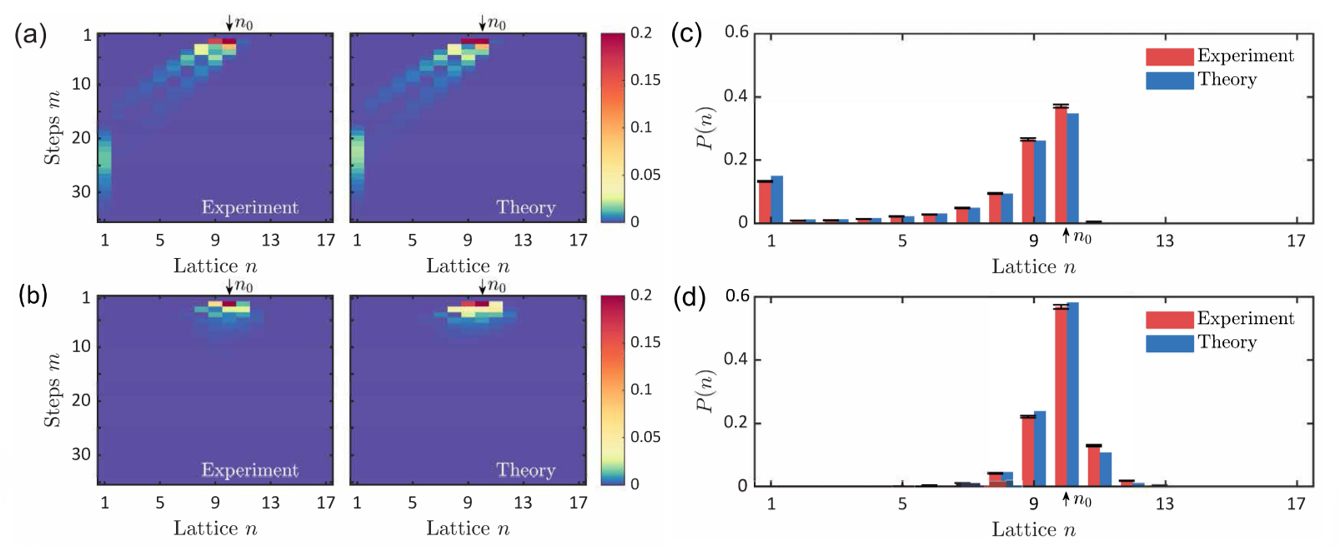
Figure 2: (a)(b) Evolution and Total Dissipation Demonstrating Non-Hermitian Edge Burst; (c)(d) Reference Experiments Without the Effect
The co-first authors of the paper are Jiankun Zhu, a Ph.D. student at SIQSE, SUSTech, and Yali Mao, a Research Assistant Professor in the Department of Physics at SUSTech. The corresponding authors are Professor Jingyun Fan (Department of Physics and SIQSE, SUSTech), Associate Researcher Zhengda Li (IQASZ), Associate Professor Bing Yang (Department of Physics, SUSTech), and Associate Professor Linhu Li from the School of Physics and Astronomy at Sun Yat-Sen University (Zhuhai Campus). The Southern University of Science and Technology is the primary affiliation for this publication. This research received substantial support from the National Key R&D Program of China, the National Natural Science Foundation of China (NSFC), the Guangdong Pearl River Talent Program (Leading Talents), the Key-Area Research and Development Program of Guangdong Province, the Guangdong Pearl River Innovation and Entrepreneurship Team, the Guangdong Provincial Key Laboratory of Quantum Precision Measurement, the Shenzhen Pengcheng Scholars Program, the Shenzhen Science and Technology Innovation Commission, and the High-level Optical Platform of the Department of Physics at SUSTech.
Paper Link: https://journals.aps.org/prl/abstract/10.1103/PhysRevLett.132.203801