
中文
中文
Recently, under the leadership of director Dapeng Yu, and in collaboration with team of Prof. Zhimin Liao at Peking University, Associate Researchers Zhenbing Tan and Jingjing Chen at the Shenzhen International Quantum Academy has achieved a great experimental progress on quantized rectification of radio-frequency (RF) signals. Superconducting materials can exhibit the superconducting diode effect—which enables unidirectional supercurrent flow—when both time-reversal and space-inversion symmetries are broken. Leveraging the superconducting diode in kagome superconductor CsV3Sb5, the team has, for the first time, realized quantized radio-frequency rectification. The results titled “Quantized radio-frequency rectification in a Kagome superconductor Josephson diode” have been published on Nature Nanotechnology on 1/30/2026.
Rectification on microwave has important applications on energy harvest, wireless charging etc. The superconducting diode has been developed in recent years, with the advantage of dissipationless. Compared to semiconductor diodes, superconducting diodes operate at ultra-low temperatures, showing promise for low temperature electrical circuits. So far, the superconducting diode is mainly studied at low-frequency regime, and its performance at radio-frequency regime is poor. CsV3Sb5 single-crystal flakes show superconducting diode effect when time-reversal symmetry is broken. The critical current of the flakes exhibits a Fraunhofer diffraction pattern under magnetic fields, a hallmark characteristic of Josephson junction. This indicates intrinsic Josephson junctions are formed within the single crystal flakes, possibly originated from superconducting domains with different superconducting orders.
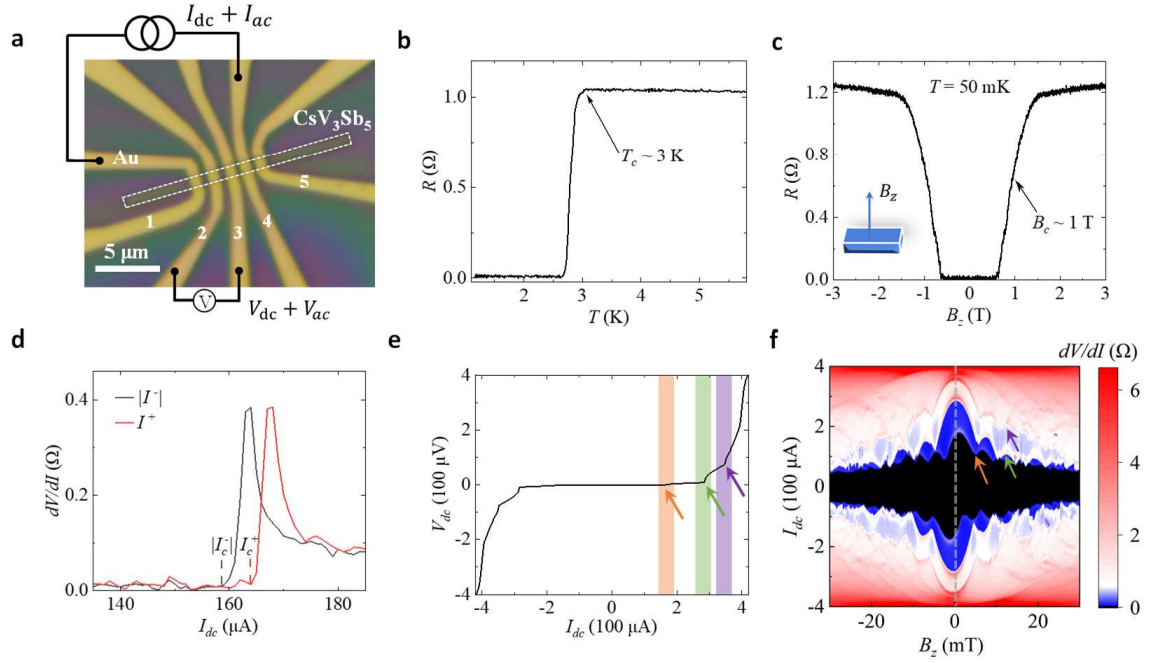
Figure 1: CsV3Sb5 single crystal flakes show superconducting diode effect and Fraunhofer diffraction pattern.
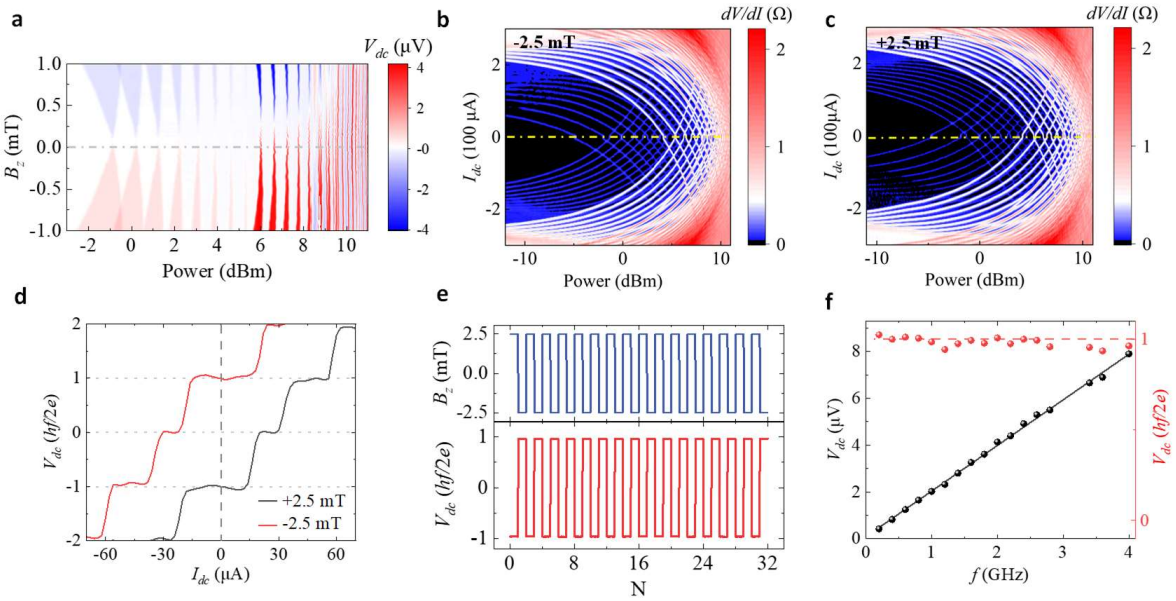
Figure 2: Quantized radio frequency rectification on a CsV3Sb5 Josephson diode.
Under radio-frequency drive, due to asymmetry of current-phase relation of the intrinsic Josephson junction in CsV3Sb5, the tilted wash board potential for the phase particle becomes steeper on the smaller critical current side, leading to the phase particle motion in one direction and thereby generating a rectified voltage. As the phase particle moves synchronized with the drive frequency, the resulting rectified voltage is proportional to the RF frequency—manifesting as a quantized rectification voltage. The polarity of the Josephson diode can be switched by reversing the magnetic field direction, allowing the polarity of the quantized rectification voltage to be flipped under magnetic control. Realization of quantized rectification voltage largely extends the superconducting diode working regime from low-frequency to radio-frequency, and tremendously improves the precision of the rectification voltage.
In this work, Hanxin Lou (Ph.D. candidate at Peking University), Jingjing Chen (Associate Researcher at International Quantum Academy and Xingguo Ye (Ph.D. candidate at Peking University) are co-first authors. Zhenbing Tan (Associate Researcher at International Quantum Academy), Anqi Wang (Associate Researcher at Peking University) and Zhimin Liao (Professor at Peking University) are corresponding authors. This work was supported by the National Natural Science Foundation of China, Quantum Science and Technology—National Science and Technology Major Project, the Dutch Research Council, Shenzhen Science and Technology Bureau, and Hefei National Laboratory.
Paper Link: https://www.nature.com/articles/s41565-025-02120-x