
中文
中文
Recently, the superconducting quantum computing team at Shenzhen International Quantum Academy (IQASZ) achieved a breakthrough in superconducting quantum chip interconnects. For the first time, the team realized microwave quantum state transfer and entanglement generation between superconducting quantum chips across the 4 K temperature stage. The results, entitled "A thermal-noise-resilient microwave quantum network up to 4 K" were published online on February 27, 2026, in the international journal Nature Electronics.

Thermal microwave quantum network.
Microwave technology underpins modern telecommunications from global satellite links to mobile networks. However, its use in the quantum domain is fundamentally limited by the thermal sensitivity of microwave photons, a consequence of their low energy (~20 μeV at 5 GHz) that renders single-photon quantum states vulnerable to ambient thermal noise. At room temperature, the blackbody radiation spectrum contains thousands of thermal photons in the microwave band, which can easily overwhelm fragile single-photon quantum states. Consequently, superconducting quantum circuits operating in the microwave regime must function in an environment close to absolute zero—typically below 20 millikelvin, provided by a dilution refrigerator—to suppress thermal excitations. While such stringent cryogenic conditions enable high-fidelity quantum control within a single dilution refrigerator, they present a significant obstacle to building scalable microwave quantum networks beyond a single cryogenic platform. The low-temperature requirement limits the development of distributed and modular superconducting architectures and hinders hybrid integration with other quantum systems—such as semiconductor quantum dots or optical interfaces—that can operate at higher temperatures (e.g., 4 K or above).
In this work, the team reports a thermal-noise-resilient microwave quantum network. Two superconducting qubits were connected by a one-meter-long niobium–titanium superconducting transmission line, enabling quantum state transfer and entanglement generation even when the transmission line was heated to 4 K. By overcoupling the communication channel to a cold load at 10 mK, the team suppresses the effective thermal occupancy of the channel to 0.06 photons through radiative cooling—a reduction of two orders of magnitude compared with the ambient thermal occupation. During quantum state transfer, the coupler was dynamically switched off, allowing state transfer and entanglement generation to be completed within the time window before the channel re-thermalized, thereby effectively suppressing thermal noise.
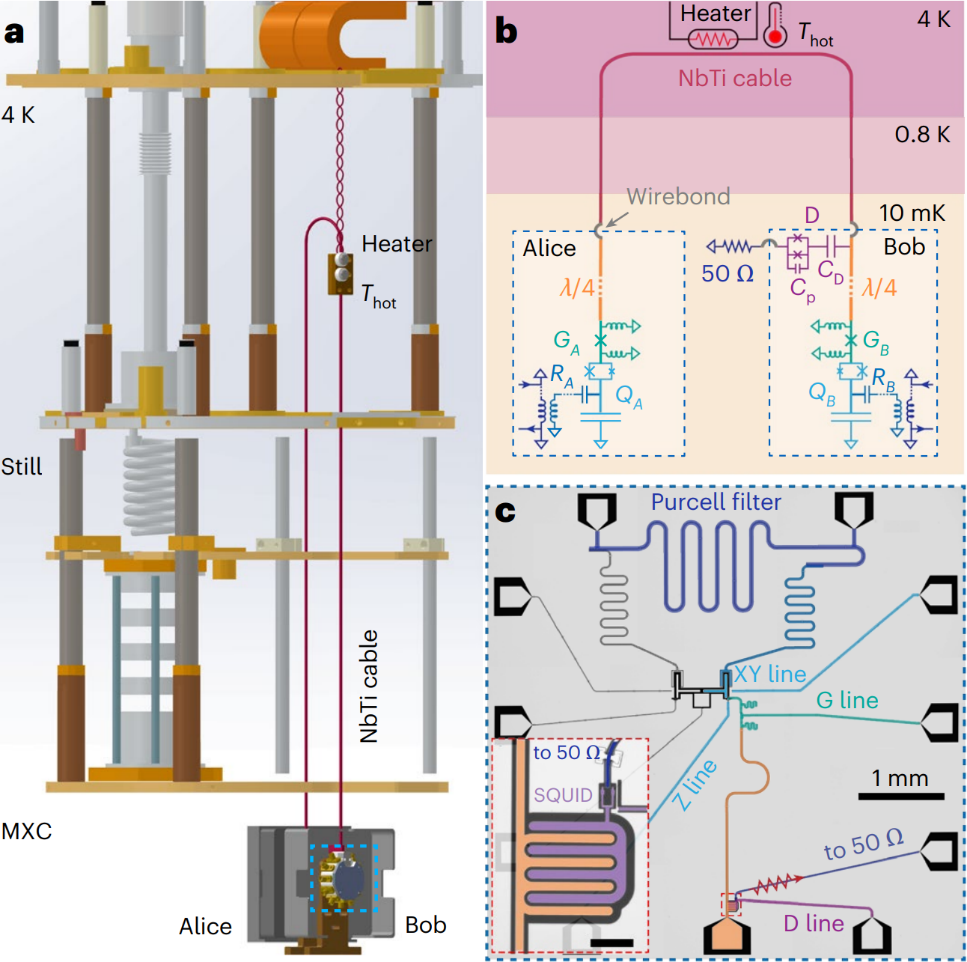
Experimental set-up.
At a channel temperature of 4 K, the protocol achieved a quantum state transfer process fidelity of 58.5% and a Bell-state fidelity of 52.3%, both surpassing the classical limit. These values were obtained without readout error correction. After correcting for readout errors, an entanglement fidelity of 93.6% was achieved at a channel temperature of 1 K, reaching the interface error-rate threshold required for fault-tolerant interconnects. A unambiguous violation of Bell’s inequality was also observed, with overall performance comparable to experiments conducted entirely in the millikelvin regime.
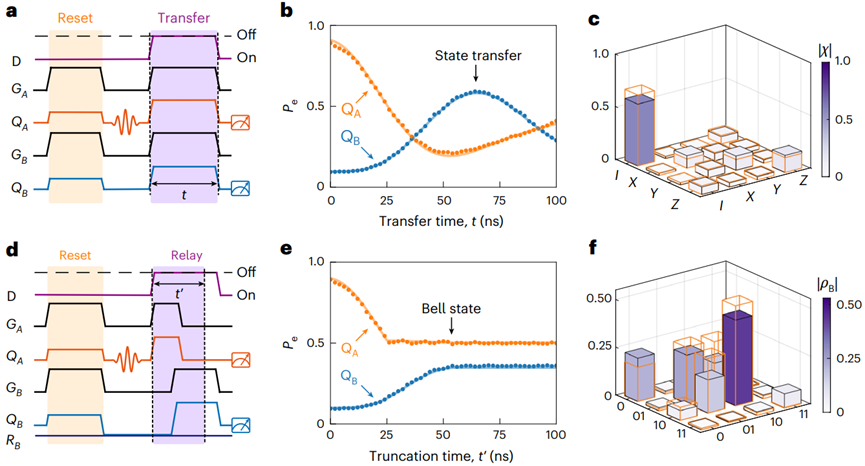
Quantum state transfer and remote entanglement at 4 K.
The paper lists Jiawei Qiu (IQASZ) and Zihao Zhang (Southern University of Science and Technology) as co–first authors. The corresponding authors are Youpeng Zhong, Jingjing Niu, and Dapeng Yu (IQASZ). This work was supported by the Science, Technology and Innovation Commission of Shenzhen Municipality, the National Natural Science Foundation of China, the Quantum Science and Technology-National Science and Technology Major Project, and the Department of Science and Technology of Guangdong Province.
Paper Link: https://www.nature.com/articles/s41928-026-01581-9