
中文
中文
Recently, Dr. Jilei Chen’s team at the Shenzhen International Quantum Academy, in collaboration with Beihang University, Universidad Técnica Federico Santa María in Chile, and the Italian National Research Council-Institute for Materials Research, published a review titled “Magnon Confinement and Trapping at the Nanoscale” in the physics review journal Physics Reports (IF = 29.5). Physics Reports is internationally recognized as a top-tier journal for physics reviews, specializing in in-depth, systematic articles written by leading experts in the field, typically publishing only one independent long review per issue. This article systematically summarizes the core physical mechanisms, key implementation strategies, and frontier applications of nanoscale magnon confinement and trapping, providing an important theoretical framework and research guidance for the development of magnonics.
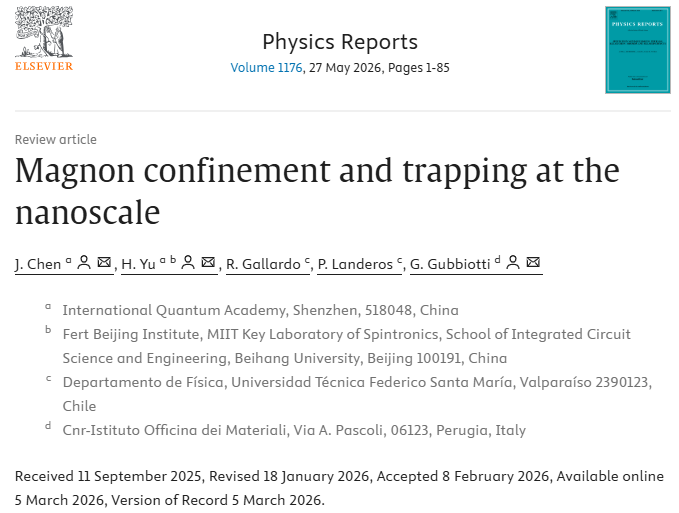
Magnons are quasiparticles arising from collective spin excitations in magnetic materials, and magnon confinement and trapping refers to localizing magnons in specific regions or structures of a magnetic medium. This concept forms a fundamental basis for magnonics research. Magnonics exploits spin waves for information transmission and processing, offering lower power consumption and higher operational speeds compared to conventional electronics, making it a promising pathway for next-generation information technologies.
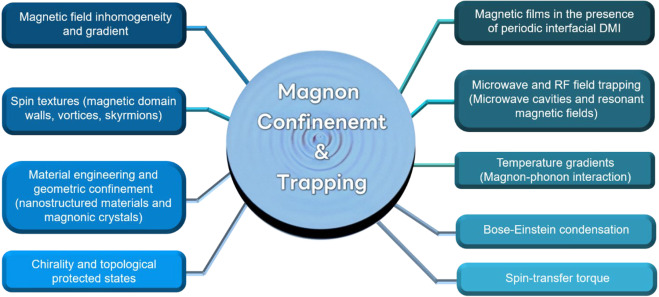
Figure 1 illustrates the main strategies and mechanisms for achieving magnon confinement and trapping.
The team systematically summarizes two major approaches for magnon confinement: static and dynamic control. Their core principle is to restrict the free propagation of magnons via potential wells or barriers, thereby stabilizing them in designated regions. The review details key technical strategies, including exploiting magnetic field inhomogeneities, spin textures (e.g., domain walls, magnetic vortices, and skyrmions), and nanostructured materials (e.g., nanowires, disks, and magnonic crystals) for magnon manipulation. It also discusses topological states, chiral magnons, and flat-band formation induced by dipole-dipole and Dzyaloshinskii-Moriya interactions. Additionally, physical mechanisms such as microwave resonant cavities, resonant magnetic fields, spin-torque oscillations, and Bose-Einstein condensation have been demonstrated to effectively achieve magnon localization. The article further reviews spin wave edge modes and cavity modes observed in two-dimensional magnetic materials and twist-angle moiré superlattices, providing new 2D platforms for nanoscale magnon control.
In terms of applications, the review highlights the potential of magnon trapping for information computation and data processing, which could advance the development of magnonic crystals, magnonic waveguides, and magnon-based memory units. Controlled magnon confinement also enhances their coupling with other quasiparticles in hybrid quantum systems, offering a pathway to overcome efficiency and scalability bottlenecks in next-generation spintronic devices.
The Shenzhen International Quantum Academy is the primary institution for this work. The corresponding authors are Dr. Jilei Chen, Prof. Haiming Yu, and Prof. Gianluca Gubbiotti. The work was supported by the National Key R&D Program of China and the National Natural Science Foundation of China.
Link to the article:
https://www.sciencedirect.com/science/article/pii/S0370157326000724