
中文
中文
Recently, Chinese scientists achieved a breakthrough in silicon-based quantum computing. Led by Academician Dapeng Yu, Researcher Yu He's team from the Shenzhen International Quantum Academy has, for the first time in the world, implemented "full-stack" logical operations—from universal logical gates to quantum algorithm demonstrations—on a silicon-based quantum processor, which is a prototype of the logical quantum computer in silicon. This work represents a critical leap from physical qubit manipulation to fault-tolerant logical encoding, marking a solid step forward towards the development of practical silicon-based quantum computers. The related research was published on March 23, 2026 on Nature Nanotechnology, with the title "Universal logical operations in a silicon quantum processor."
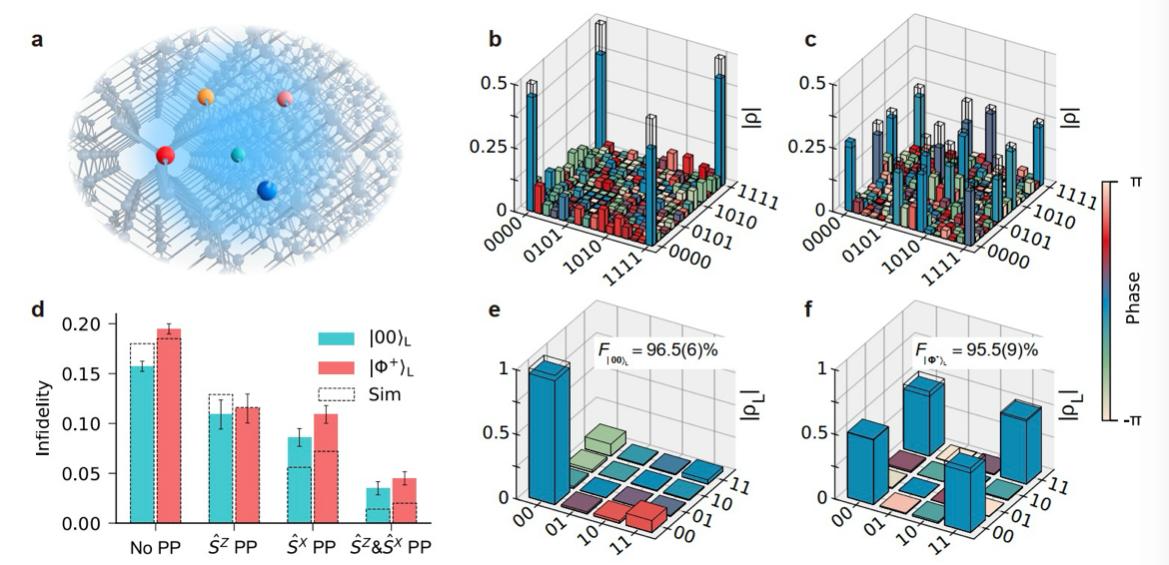
Quantum computing holds immense potential, but computational errors induced by environmental noise pose a core obstacle to its practical application. Fault-tolerant quantum computing is the fundamental solution, the core of which is encoding information into "logical qubits" for redundancy and error correction, akin to putting a "protective suit" on the information. Silicon-based spin qubits are considered among the most promising platforms for building large-scale quantum processors due to their long coherence times, high control precision, and natural compatibility with existing semiconductor chip fabrication processes. Despite significant progress in recent years, achieving fault-tolerant logical encoding and universal logical operations has remained an unresolved challenge.
Core Breakthrough: The Leap from "Physical Qubits" to "Logical Encoding"
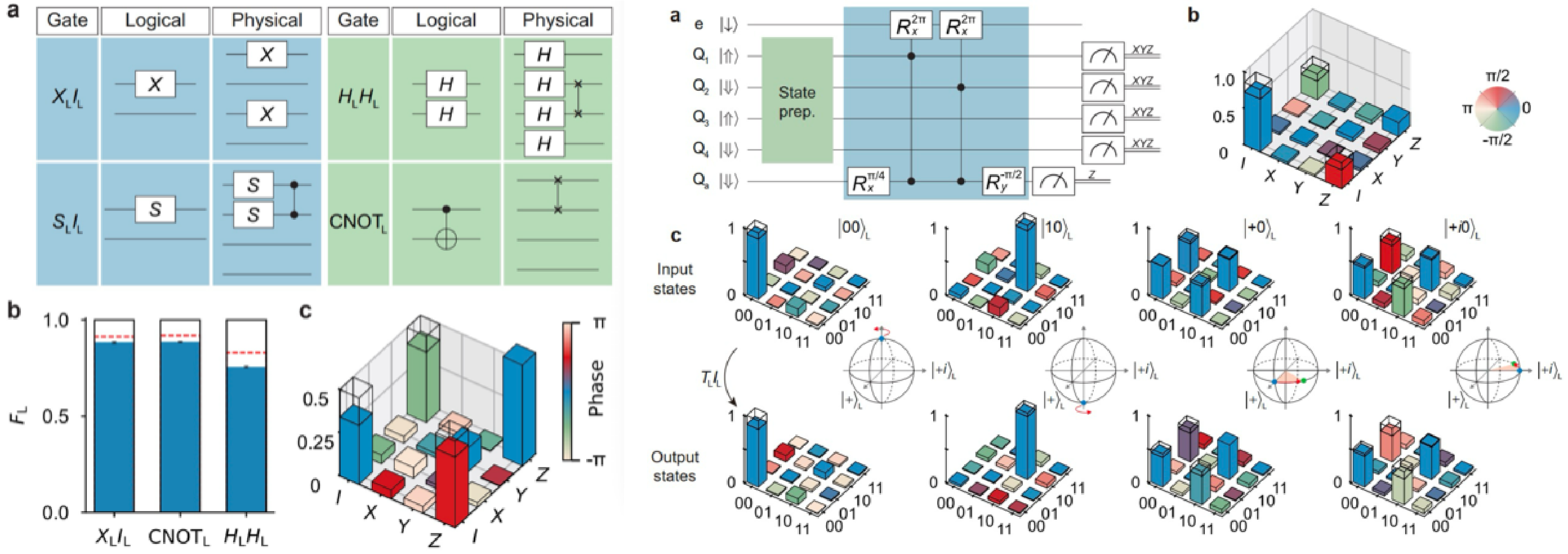
The research team utilized scanning tunneling microscopy (STM) nanofabrication technology to prepare an atomically precise silicon-based quantum processor based on phosphorus atom clusters. The designed phosphorus cluster architecture enables good addressability of physical qubits and efficient multi-qubit gates, while developed crosstalk suppression schemes provide the fundamental guarantee for high-fidelity control. The team employed the efficient [[4,2,2]] quantum error-detecting code to encode two logical qubits using four physical nuclear spins. The [[4,2,2]] code is one of the smallest building blocks for constructing fault-tolerant logical qubits and can serve as a key foundational module for future large-scale concatenated error-correction architectures.
The research team achieved a series of closely interconnected core breakthroughs.
The most central breakthrough of this work lies in the first demonstration of a complete set of universal logical quantum gates. The team not only realized all necessary single- and two-qubit Clifford logical gates but, more crucially, successfully implemented the logical T gate using a gate-by-measurement method compatible with future fault-tolerant architectures. This gate is an indispensable but difficult-to-implement key component for building a universal quantum computer; combined with Clifford gates, it can perform universal quantum computing tasks. This signifies that all core logical components required for building a universal fault-tolerant quantum processor on a silicon-based platform are now in place.
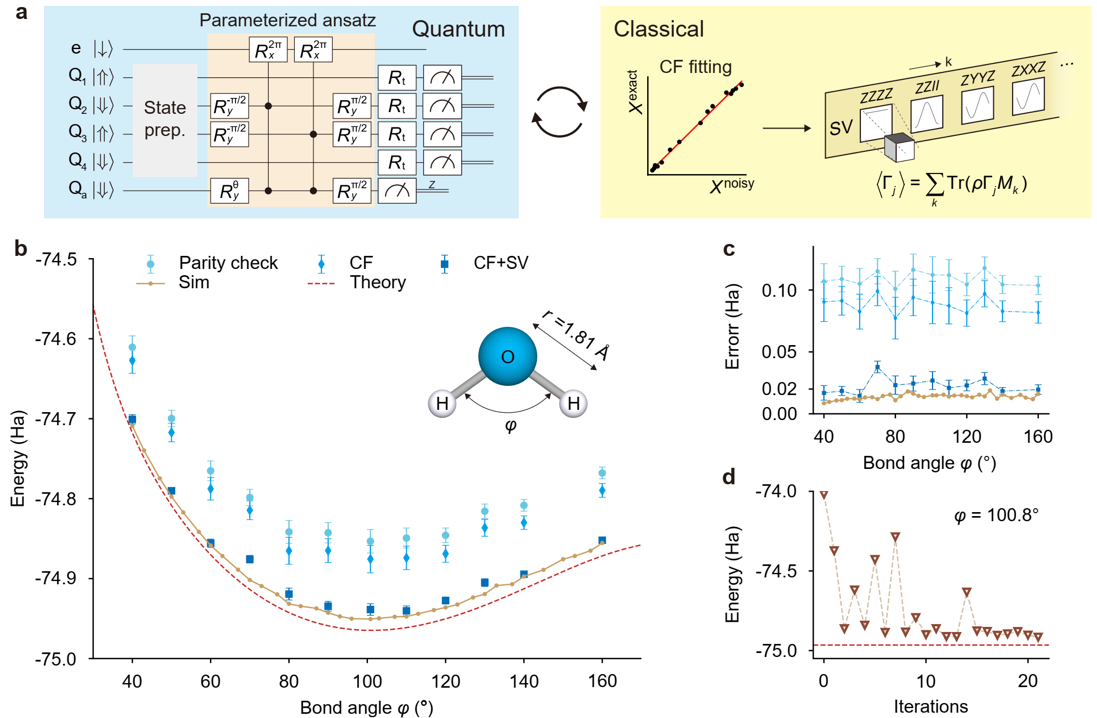
To demonstrate the practical potential of this logical processor, the team, for the first time, completed a quantum algorithm demonstration and solved a practical problem using silicon-based logical qubits. They successfully ran the "Variational Quantum Eigensolver" algorithm on two logical qubits to accurately simulate the electronic ground-state energy of a water molecule (H₂O). The calculation result showed an error of only 20 mHa compared to the theoretical value, with the potential to meet chemical accuracy requirements in the future. This fully proves the feasibility of running practical quantum algorithms with this logical encoding scheme.
Furthermore, the team for the first time prepared the essential "logical magic states" for fault-tolerant computing in a silicon-based system, and their fidelity surpassed the theoretical threshold for "magic state distillation", laying the resource foundation for future fault-tolerant computation. The team also demonstrated fault-tolerant preparation of logical quantum states, significantly improving their fidelity through post-processing steps. The experiments further confirmed a unique error bias in the silicon-based quantum system—"strong biased noise" (where phase-flip errors far more than bit-flip errors). This characteristic aids in the future design of more efficient and resource-saving dedicated error-correction schemes.
Summary and Outlook
This work achieves, for the first time in the world, "full-stack" logical operations in a silicon-based quantum processor—encompassing logical state preparation, universal logical gate operations, and quantum algorithm demonstration. It is a key milestone on the path to scalable, fault-tolerant quantum computing. Looking ahead, by suppressing signal crosstalk, scaling up the system (e.g., building arrays of atom clusters), and fully utilizing unique physical properties of this system, such as noise bias, more efficient fault-tolerant schemes can be designed. This will accelerate the advancement of this quantum computing path, which is compatible with the existing semiconductor industry, towards practical application.
In this study, Chunhui Zhang (IQASZ/SUSTech PhD candidate), Feng Xu (IQASZ/SUSTech PhD candidate), Shihang Zhang (IQASZ/SUSTech PhD candidate), and Mingchao Duan (IQASZ Researcher) from the Shenzhen International Quantum Academy are the co-first authors of the paper. Academician Dapeng Yu, Researcher Yu He, Associate Researcher Peihao Huang, and Associate Researcher Tianluo Pan are the co-corresponding authors. The team of Researcher Xiao Yuan from Peking University provided support in VQE algorithms. The research received support from the National Natural Science Foundation of China, the Quantum Science and Technology-National Science and Technology Major Project, the Shenzhen Science and Technology Program, the Guangdong Basic and Applied Basic Research Foundation.
Paper Link:https://www.nature.com/articles/s41565-026-02140-1