
中文
中文
Recently, an international research collaboration coordinated by Georg Engelhardt at the Shenzhen International Quantum Academy, in collaboration with researchers from Zhejiang University of Science and Technology, the Instituto de Ciencia de Materiales de Madrid, and Southern University of Science and Technology, made crucial progress in continuous quantum measurement and superconducting qubit readout. Focusing on dispersive readout in a squeezed environment, the team developed a new statistical analysis framework that enables a more complete description of how measurement signals evolve as they accumulate over time, and directly links these statistical features to measurement precision. The study shows that a squeezed environment can significantly improve the sensitivity and accuracy of dispersive readout, making the system more responsive to tiny changes. At the same time, this improvement remains relatively stable even in the presence of weak nonlinear disturbances. The related work was published in Physical Review Letters under the title Full-counting statistics and quantum information of dispersive readout with a squeezed environment.
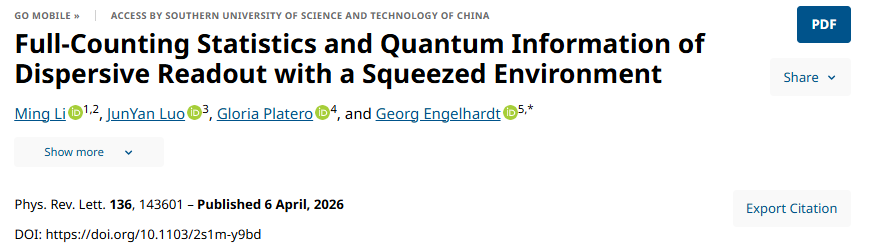
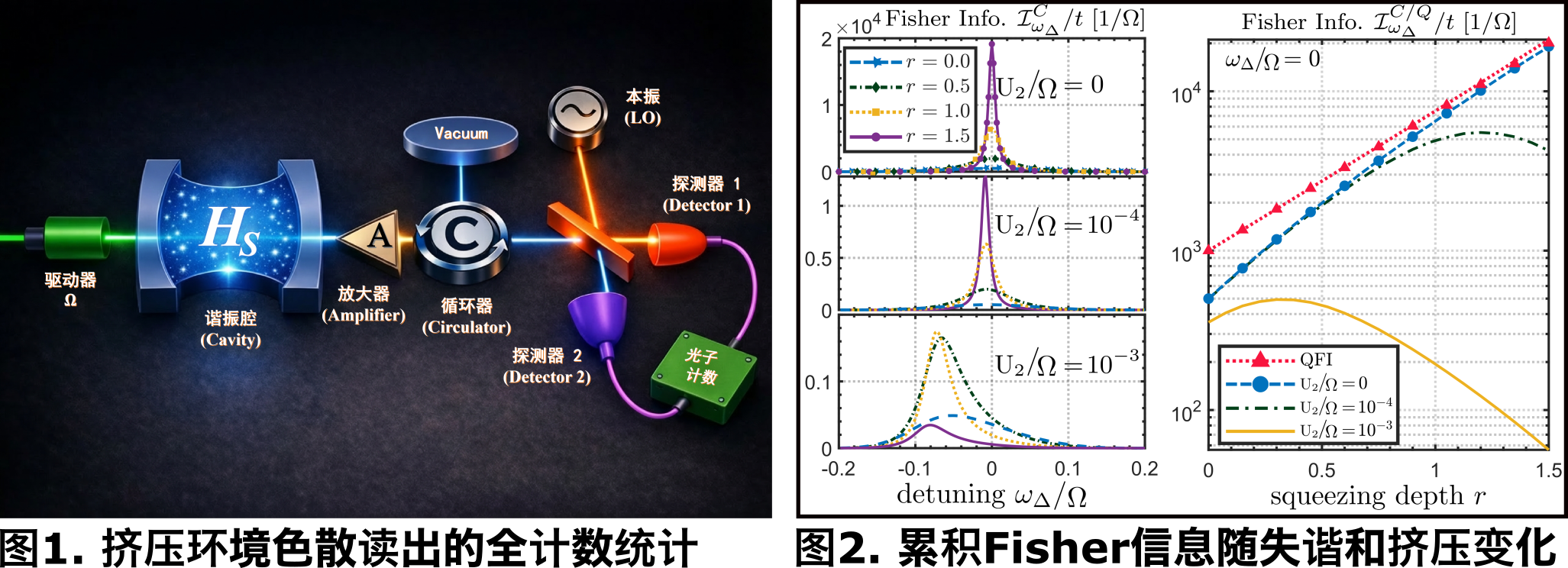
Dispersive readout is a key method for measuring superconducting qubits. Its basic idea is that the qubit induces a tiny change in the resonator, and this change is then extracted from the output signal. Conventional theories are usually well suited to analyzing average signals, but they become limited when the measurement process is more complex or when one needs to further study the statistical patterns that emerge as the signal accumulates over time. To address this problem, the research team designed a dispersive-readout scheme based on a squeezed environment and developed a corresponding full-counting-statistics approach to describe more completely how the measurement signal evolves during temporal accumulation, as well as how these statistical features are connected to measurement precision. The results show that a squeezed environment can significantly enhance the system’s response to tiny changes while suppressing measurement noise, thereby improving readout precision. Under strong squeezing, this improvement can even approach the quantum limit. Further study also shows that the scheme remains relatively stable in the presence of weak nonlinear disturbances. This work provides a new theoretical perspective for the design and improvement of continuous quantum measurements and high-fidelity readout of superconducting quantum devices.
The first author of this paper is Ming Li, a postdoctoral researcher at Southern University of Science and Technology, and the corresponding author is Researcher Georg Engelhardt of the Shenzhen International Quantum Academy. This research was supported by the National Natural Science Foundation of China.
Link to the article:
https://doi.org/10.1103/2s1m-y9bd