
中文
中文
Recently, the research team led by Associate Researchers Yao Lu and Junhua Zhang at Shenzhen International Quantum Academy has made notable progress in the field of trapped-ion quantum computing. The team successfully constructed the first trapped-ion quantum processor based on structured light addressing, and first demonstrated a scalable entangling gate scheme on this platform. This achievement effectively alleviates a critical challenge in scaling trapped-ion processors to long ion chains, namely the motional mode spectral crowding problem, and provides a highly viable pathway toward realizing long-chain trapped-ion quantum processors at the hundred-qubit scale. Based on this scheme, the research team conducted experimental validations in systems ranging from two- to six-ion chains. The results show consistent Bell-state preparation fidelities at various system sizes, which validates the reliability of this method during system scale-up. The research work, entitled "Scalable entangling gates on ion qubits via structured light addressing", was published online on April 1st.
In the pursuit of practical quantum computing, the trapped-ion platform has emerged as a compelling candidate for large-scale fault-tolerant quantum computing, benefiting from its high-fidelity gate operations, long coherence times, and inherent all-to-all connectivity among qubits. In particular, the scalable architecture based on one-dimensional long ion chains supports the efficient scaling of qubit numbers, making it a crucial technical pathway for constructing large-scale trapped-ion quantum processors.
However, as the number of ions increases, long-chain processors encounter a critical bottleneck in entangling gate performance, primarily due to the spectral crowding of radial motional modes. In trapped-ion systems, qubit entanglement relies on the collective motional modes of the ion crystal acting as a mediator. As the system scales up, the motional mode spectrum becomes increasingly dense, leading to unavoidable coupling to multiple modes during entangling operations. This makes it extremely challenging to achieve complete decoupling of all motional modes at the end of the gate operation, thereby significantly increasing entangling gate errors. Furthermore, constrained by the physical implementation of individual ion addressing optical paths, traditional entangling approaches typically rely on radial modes with a much denser spectrum, which further exacerbates the scalability challenge.
In contrast, axial motional modes, which exhibit a much sparser spectrum, offer a promising pathway to overcome this bottleneck. To address the difficulties in efficient axial coupling using conventional addressing techniques, the research team developed a trapped-ion quantum processor equipped with Hermite-Gaussian addressing beam arrays. By exploiting the transverse electric field gradient of the structured light field, this system enables selective coupling of specific ion qubits to the desired axial motional modes. Leveraging the sparser spectral features of the axial modes, this scheme can effectively isolate a single or few modes as the entanglement mediator, thereby significantly alleviating the spectral crowding issue in long ion chains.
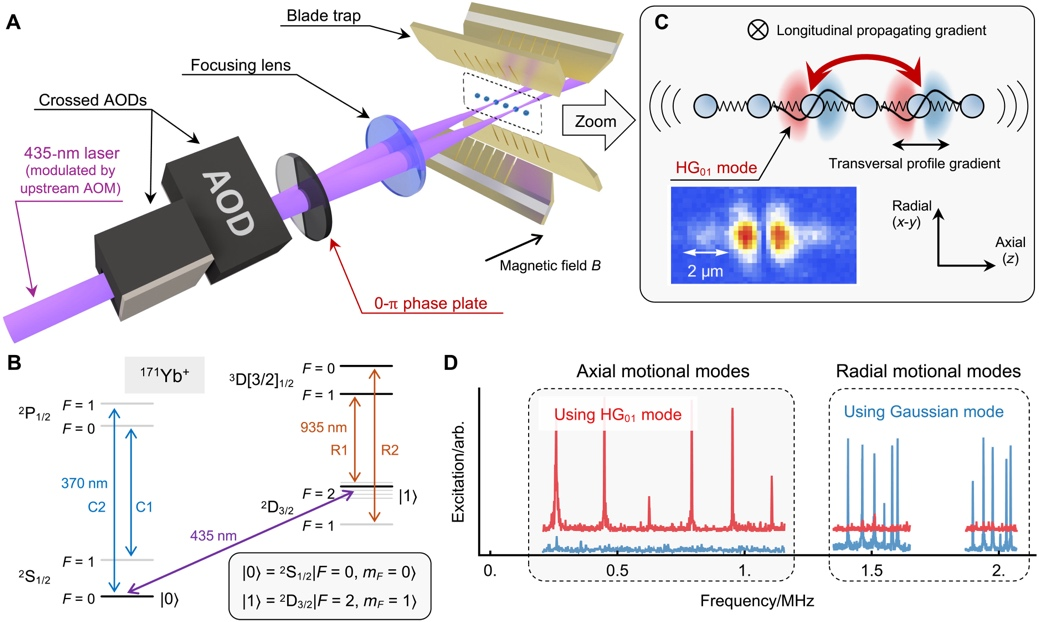
Figure 1. Trapped-ion quantum processor via Hermite-Gaussian light addressing
On this novel trapped-ion quantum processor, the research team experimentally demonstrated the coherent manipulation of ion qubits and two-qubit entangling gate operations based on Hermite-Gaussian structured light fields. In ion chains ranging from two to six ions, the Bell-state preparation fidelity achieved using this entangling gate scheme remained consistent at approximately 0.97. The residual errors, primarily originating from technical noises, can be further suppressed through systematic optimization. Notably, by aligning ions with either the electric field amplitude maxima or gradient maxima of the light field, this addressing scheme supports a complete set of universal quantum logic gate operations.
Further theoretical analysis and numerical simulations indicate that axial motional modes retain the considerable advantage of spectral sparsity as the number of qubits increases. Even at the hundred-ion scale, high-fidelity entanglement between arbitrary ion pairs can still be achieved by coupling only a small number of motional modes facilitated by relatively simple pulse shaping techniques.
The control scheme developed in this research substantially reduces system control complexity and engineering challenges while preserving gate scalability, thereby greatly simplifying the construction of intermediate-scale trapped-ion quantum computing systems. Moreover, owing to its high compatibility with scaling architectures such as Quantum Charge-Coupled Device (QCCD), this method is expected to markedly reduce the ion transport overhead, providing crucial support for the realization of practical, large-scale quantum processors.
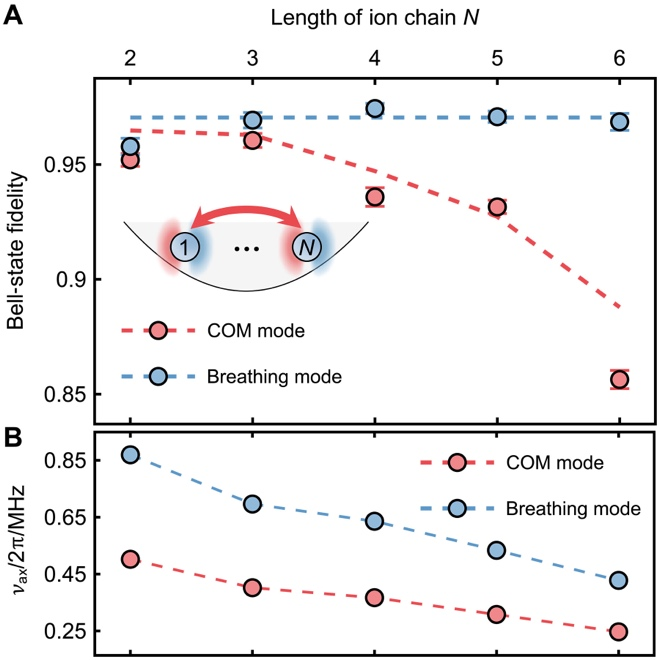
Figure 2. Entanglement fidelities scaling with ion-chain length
Publication Information
In this work, Xueying Mai (Ph.D. student at IQASZ/SUSTech) is the first author of the paper. Associate Researchers Yao Lu and Junhua Zhang at SIQA are the corresponding authors. Other contributing authors include Assistant Researcher Liyun Zhang and Qiyang Yu (Master's student at IQASZ/SUSTech). This research work was supported by the Guangdong Basic and Applied Basic Research Foundation, Hefei National Laboratory, the National Science Foundation of China, and the Shenzhen Science and Technology Program.
Paper Link: https://www.science.org/doi/10.1126/sciadv.aec0392