
中文
中文
Recently, researchers from the Shenzhen International Quantum Academy (IQASZ), Peking University, Shandong University, and Nankai University have made significant progress in the efficient experimental estimation of quantum Fisher information (QFI). The research team experimentally implemented the Krylov shadow tomography (KST) protocol on a photonic quantum platform supporting up to six qubits and achieved high-accuracy QFI estimation. Under matched-resource conditions, KST yielded a substantially lower mean absolute error than representative existing methods. A phase-estimation experiment further showed that the resulting estimates accurately predict the ultimate parameter-estimation precision set by the quantum Cramér–Rao bound. This work, entitled "Gap-closing experimental estimation of quantum Fisher information", was published on September 9, 2026.
Quantum Fisher information is a central quantity in quantum metrology. Through the quantum Cramér–Rao bound, it sets the theoretical lower bound on the variance of parameter estimates and thereby characterizes the ultimate precision allowed by a quantum system. It is also widely used to certify metrologically useful entanglement, probe quantum critical phenomena, and assess the performance of quantum devices. However, QFI depends highly nonlinearly on the quantum state. The resources required for full quantum state tomography grow exponentially with system size, while existing alternatives often suffer from overly loose estimation bounds or prohibitively high costs for guaranteed convergence. Obtaining QFI estimates that reliably approach the true value with scalable experimental resources has therefore remained a key challenge in quantum metrology.
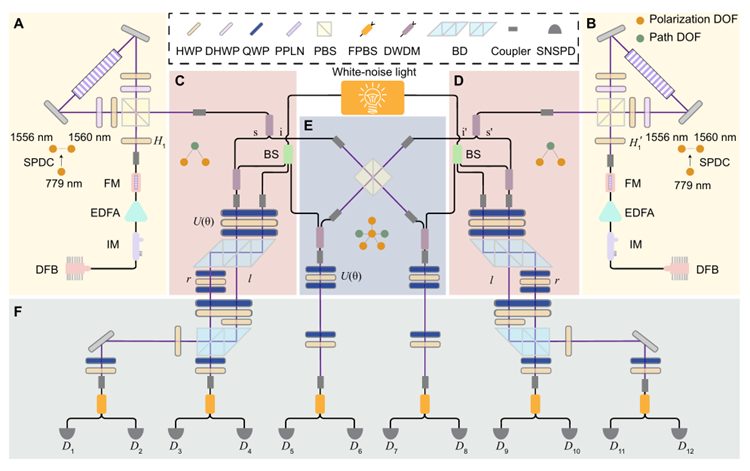
Figure 1: Experimental setup
To address this challenge, the team experimentally implemented the recently proposed Krylov shadow tomography (KST) protocol. The photonic quantum platform uses the polarization and path degrees of freedom of photons to encode polarization and path qubits, respectively, enabling the preparation of Greenberger–Horne–Zeilinger (GHZ) states of up to six qubits under controllable noise. Under matched-resource conditions, the team compared KST with other representative methods and found that KST exhibits the theoretically predicted gap-closing behavior while achieving a substantially lower mean absolute error. The team further demonstrated that the high-accuracy QFI estimates obtained with KST correctly predict the ultimate precision achievable in a phase-estimation experiment, as dictated by the quantum Cramér–Rao bound. These findings establish KST as a scalable and practical experimental tool for the efficient characterization and utilization of quantum resources in metrological applications.
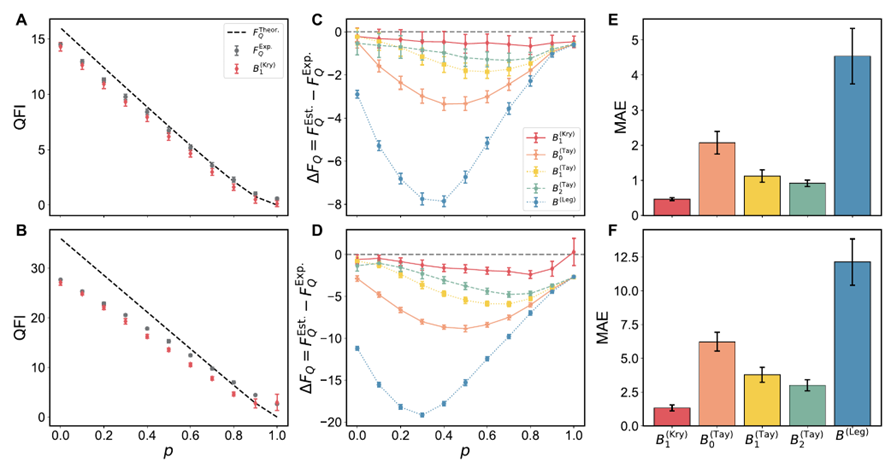
Figure 2: QFI estimation at different white-noise levels
This work advances KST from a theoretical estimation protocol to a quantum characterization tool validated through systematic experiments, providing a scalable route to QFI estimation in noisy quantum systems. The method can assess the metrological usefulness of complex quantum states and provide an experimental basis for the characterization and optimization of quantum sensors and quantum processors.
The Shenzhen International Quantum Academy (IQASZ) was the primary institution for this research. Qian-Xi Zhang (IQASZ/SUSTech) and Qi-Ming Ding (Peking University) are co-first authors. The corresponding authors are Da-Jian Zhang (Shandong University), Xiao Yuan (Peking University), and Zheng-Da Li (IQASZ). Key collaborators include Ya-Li Mao (Nankai University). The research was supported by the Quantum Science and Technology-National Science and Technology Major Project, the National Natural Science Foundation of China, the Guangdong Basic and Applied Basic Research Foundation, the Tianjin Natural Science Foundation Project, the Beijing Natural Science Foundation, the Shandong Provincial Young Scientists Fund, and other organizations.
Paper Link: https://www.science.org/doi/10.1126/sciadv.aef4342