
中文
中文
Recently, the Integrated Photonics Laboratory in International Quantum Academy, together with collaborators, made major progress in understanding broadband dispersion control in silicon nitride photonic chips. For the first time, the team systematically established the physical link between residual hydrogen, broadband material dispersion, and phase matching in nonlinear microresonators. The work reveals how residual hydrogen modifies the dispersion of silicon nitride: N—H bond absorption in the mid-infrared (MIR) and hydrogen-induced changes in ultraviolet electronic transitions jointly affect dispersion in the near-infrared (NIR) and visible through the Kramers—Kronig (KK) relations, but with opposite contributions. The two effects are predicted to nearly cancel at around 2 μm. The work, entitled "Kramers—Kronig causality in integrated photonics: The spectral tension between ultraviolet transition and midinfrared absorption," was published in Physical Review Letters on September 22, 2026.
With ultralow optical loss, a broad transparency window, and favorable nonlinear properties, silicon nitride is an important material platform for integrated photonic technologies such as optical frequency combs, supercontinuum generation, optical parametric oscillation, and quantum light sources. Realizing these functions requires precise control of dispersion, namely the wavelength-dependent propagation of light in a chip. However, existing designs commonly rely on idealized refractive-index models that assume a completely pure material, and the operating wavelengths of actual devices often deviate from design predictions. Understanding how trace impurities affect dispersion has therefore become a key challenge for high-precision photonic-chip design.
To address this challenge, the team found that hydrogen remaining after chip fabrication does not merely cause localized absorption loss; it also alters the refractive index and dispersion over multiple spectral bands. The weak absorption peak observed near 1.52 μm in the telecommunications band is only a fingerprint of residual hydrogen, rather than the fundamental origin of the dispersion change. The change is instead dominated by two widely separated spectral processes: the fundamental N-H molecular vibration near 3 μm in the MIR, and hydrogen-induced changes in ultraviolet electronic transitions. These processes can jointly influence visible and NIR dispersion because of the spectral nonlocality revealed by the KK relations. As an expression of causality in optics, the KK relations establish that absorption and refractive index are interrelated: a change in absorption in one spectral band produces changes in the refractive index across the entire spectrum. Because dispersion describes the variation of refractive index with optical frequency or wavelength, ultraviolet electronic transitions and MIR N—H molecular vibrations can reshape the refractive-index curve and thereby control dispersion in the visible and NIR even though they lie far from those operating bands.
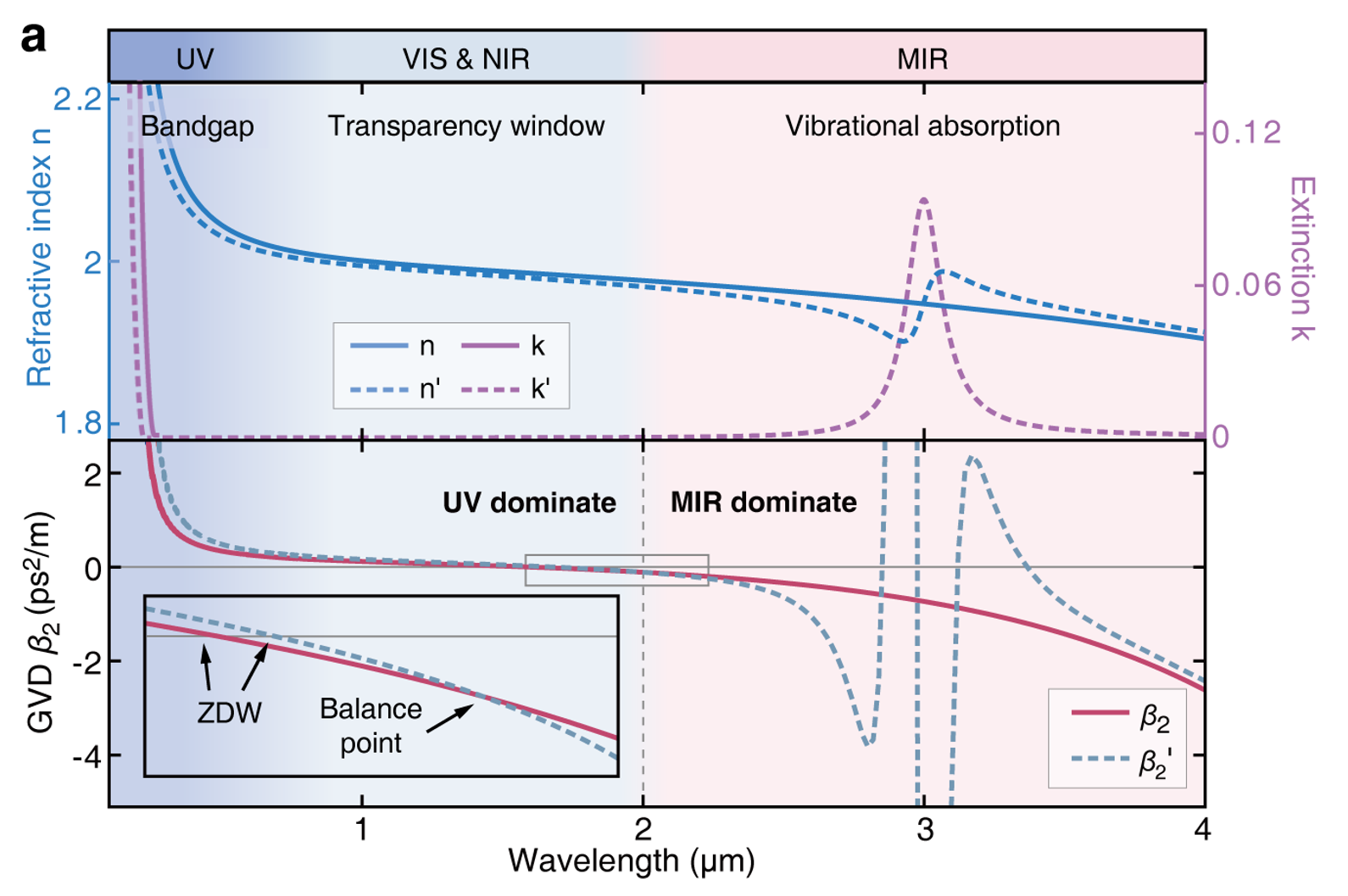
Figure 1. Nonlocal effects of residual hydrogen in silicon nitride on dispersion. Residual N—H bonds not only produce an absorption peak near 3 μm, but also modify ultraviolet electronic transitions in silicon nitride, including a bandgap blueshift. The two mechanisms have opposite effects on NIR dispersion and cancel each other near 2 μm.
The team systematically validated this mechanism by varying the hydrogen content in silicon nitride through annealing at different temperatures and combining Fourier-transform infrared spectroscopy, ellipsometry, and microresonator measurements across the near-visible, NIR, and MIR bands. After sufficient annealing removed the N—H bonds, hydrogen-related absorption largely disappeared, the dispersion curve of the same chip shifted markedly, and the desired phase-matching point emerged. Structural measurements also confirmed that the waveguide geometry remained essentially unchanged before and after annealing, ruling out geometric deformation as the source of the dispersion change.
The study further shows that MIR N—H vibrations and ultraviolet electronic transitions contribute to NIR dispersion with opposite signs: the former makes a negative contribution, whereas the latter makes a positive contribution. The two effects compete and nearly cancel near 2 μm, creating a dispersion-balance point that is insensitive to hydrogen content. Notably, even when residual hydrogen introduces only a weak loss of a few decibels per meter, it can substantially shift the dispersion curve and phase-matching wavelength of a microresonator. This finding demonstrates that trace impurities cannot be neglected in precision dispersion engineering.
In this work, Yue Hu and Zhenyuan Shang, jointly trained doctoral students at International Quantum Academy and Southern University of Science and Technology, are co-first authors. Researcher Junqiu Liu of International Quantum Academy is the corresponding author. The teams of Professor Xinmao Yin at Shanghai University and Professor Zhichuan Niu at the Institute of Semiconductors, Chinese Academy of Sciences, also made important contributions. This work was supported by the National Science and Technology Major Project, the National Natural Science Foundation of China, the National Key R&D Program of China, the Guangdong-Hong Kong Technology Cooperation Funding Scheme, the Shenzhen Science and Technology Program, and Shenzhen-Hong Kong Cooperation Zone for Technology and Innovation.
Paper link: https://journals.aps.org/prl/abstract/10.1103/jnwg-3m6r