
中文
中文
Recently, under the leadership of Prof. Dapeng Yu, the research groups led by Prof. Tao Xin and Prof.. Yu He at Shenzhen International Quantum Academy made important progress in the control of multiparticle entanglement of atomic spins in silicon. On an atomically precise silicon atomic quantum-computing chip, the team achieved for the first time the complete preparation and full characterization of all four-partite entanglement families among four nuclear spins, breaking through the decade-long limitation that silicon spin systems could generate only a single type of GHZ entanglement, and providing rich entanglement resources for future applications in silicon quantum computing, quantum networks, and quantum sensing. The results, titled "Multiparticle Entanglement of Nuclear Spins in Silicon", were published online in Nature Communications on June 25, 2026.

Silicon spin qubits, owing to their high-fidelity control and compatibility with semiconductor fabrication processes, have become an important candidate platform for quantum information processing. One key step toward practical quantum applications is the ability to systematically construct diverse quantum entanglement on this platform. At present, this technology route has been mainly limited to the preparation of GHZ entanglement. Although such entanglement is easy to generate and verify, it is fragile under noise and cannot meet the demand of future quantum applications for complex and diverse entanglement resources. To address this bottleneck, the research team built a silicon donor quantum processor by combining atomically precise scanning tunneling microscopy hydrogen lithography with semiconductor chip fabrication, thereby enabling the complete preparation and control of multiparticle entanglement resources in atomic spin systems in silicon.
In this work, by precisely controlling the multiparticle nuclear-spin interactions in the silicon atomic system, the team developed a quantum-entanglement preparation technique tailored to the native physical gate set of silicon. Using a bidirectional breadth-first search algorithm to design shallow quantum circuits, they experimentally realized, for the first time, the complete generation of all four-partite entanglement families. They further used scalable quantum overlapping tomography to systematically characterize the multiparticle entangled states, verifying genuine four-qubit entanglement, entanglement structure, and robustness against qubit loss. By testing multipartite Bell-type inequalities, this work further demonstrated genuine four-qubit nonlocality in the system, moving beyond the previous situation in which silicon systems had only observed two-qubit nonlocality. In addition, the team extended entanglement generation to the mixed-state space, prepared high-quality noise-induced quantum bound entangled states, and successfully "unlocked" bound entanglement through joint Bell measurements, achieving a sevenfold quantum-entanglement distillation gain.
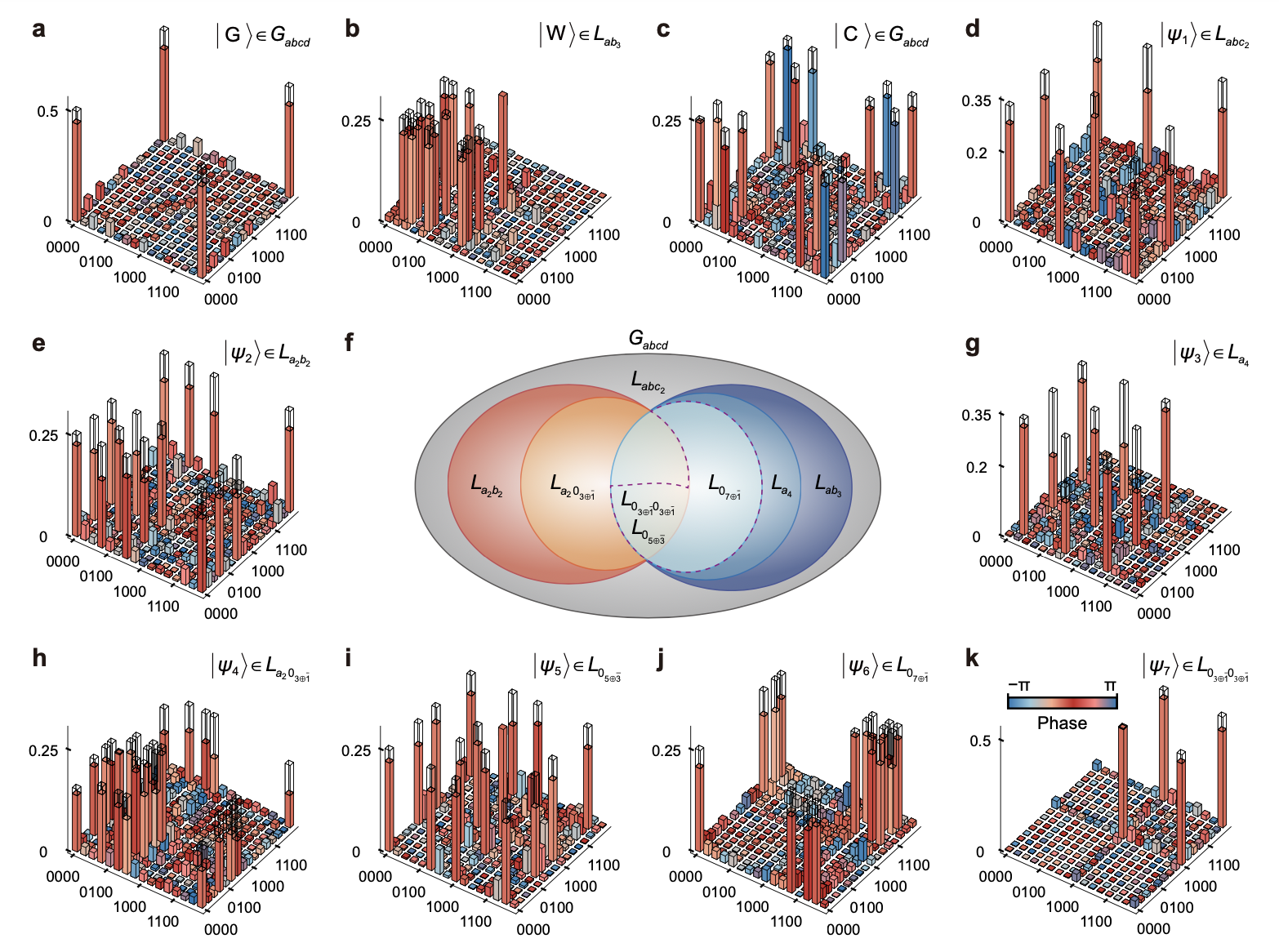
Fig. 1. Preparation and characterization of the complete family of four-qubit entanglement in silicon
This work systematically establishes advanced multiparticle-entanglement capability on a solid-state spin-qubit platform across multiple dimensions, including entanglement diversity, entanglement quality, entanglement nonlocality, and entanglement distillability. It breaks the decade-long restriction of silicon spin systems to GHZ-type entanglement and expands the library of silicon quantum-entanglement resources. As silicon technology moves rapidly toward large-scale fault-tolerant quantum computing, this achievement provides a key technical foundation for using complex multiparticle entanglement in frontier areas such as quantum simulation, quantum-enhanced metrology, distributed quantum computing, and quantum interconnects.

Fig. 2. Preparation of quantum bound entanglement and entanglement distillation of atomic spins in silicon
In this work, Feng Xu (Ph.D. student at IQASZ/SUSTech), Yi Deng (Ph.D. student at IQASZ/USTC), and Guangchong Hu (Associate Researcher at IQASZ) are the co-first authors. Tao Xin and Yu He at IQASZ are the corresponding authors. This work was supported by the Quantum Science and Technology-National Science and Technology Major Project, the National Natural Science Foundation of China, Shenzhen Science and Technology Program, Guangdong Basic and Applied Basic Research Foundation and other institutions.
Paper link: https://www.nature.com/articles/s41467-026-74491-1