
中文
中文
Recently, the research group led by Prof. Jilei Chen at the Shenzhen International Quantum Academy, in collaboration with researchers from several institutions, has made important progress in the study of dark magnons in antiferromagnets. The team has experimentally demonstrated the detection of dark magnons in a heterostructure composed of a van der Waals antiferromagnet and a ferromagnetic insulator. This work provides a new physical mechanism for developing low-power magnonic devices and controlling quantum spin information. The findings were published in Nature Communications in October 2026 under the title “Observation of dark magnons in a van der Waals antiferromagnet/ferromagnet interface”.
Spin waves are collective excitations arising from the coherent precession of electron spins in magnetic materials, and their quanta are known as magnons. In antiferromagnetic systems, the precession of the two spin sublattices can form two distinct modes: an in-phase mode and an out-of-phase mode. The in-phase mode possesses a nonzero net dynamic magnetization and can therefore couple directly to microwave electromagnetic fields. It is referred to as a bright magnon. In contrast, the dynamic magnetizations of the two spin sublattices cancel each other in the out-of-phase mode, resulting in a nearly vanishing net dynamic magnetization and extremely weak coupling to external electromagnetic fields. This mode is therefore known as a dark magnon. Owing to their weak coupling to external electromagnetic fields, dark magnons are expected to exhibit reduced radiative losses, potentially offering longer coherence lifetimes and lower propagation dissipation. They are therefore considered promising candidates for carrying spin-wave information in antiferromagnets. However, their near-decoupling from electromagnetic fields also makes them extremely difficult to excite and detect using conventional microwave techniques, posing a longstanding experimental challenge in antiferromagnetic magnonics.
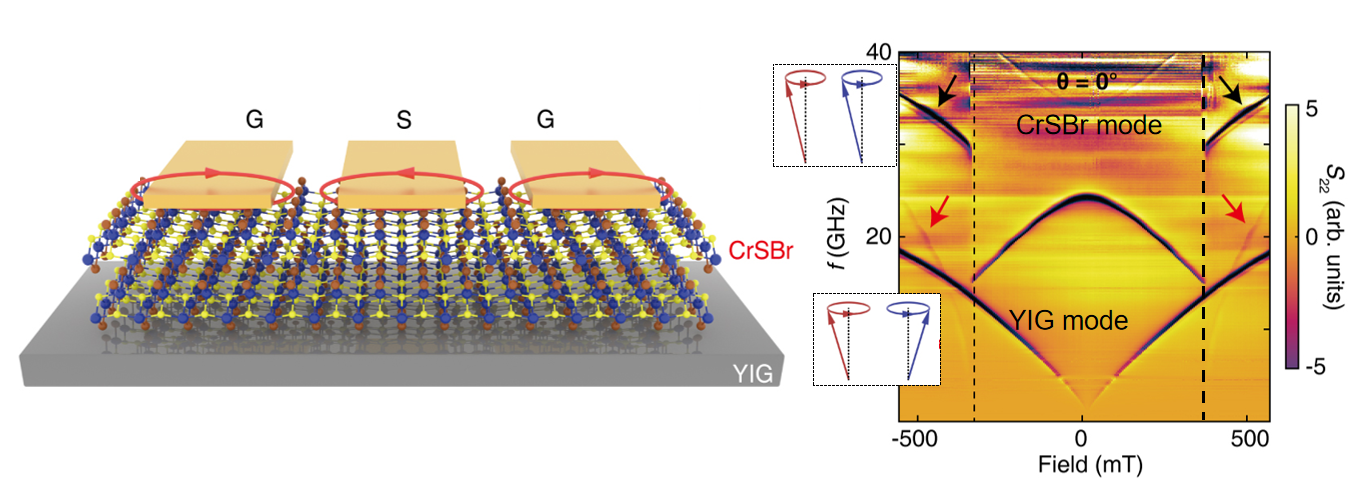
Figure 1 Schematic illustration of the heterostructure consisting of a two-dimensional antiferromagnet CrSBr and a ferromagnetic insulator YIG, together with the experimental results demonstrating the detection of antiferromagnetic dark magnons.
To address this challenge, the research team investigated CrSBr, a representative van der Waals antiferromagnet. In the spin-flip phase of CrSBr, one of its magnon modes exhibits the characteristic features of a dark magnon, with a nearly vanishing net dynamic magnetization. The team fabricated a heterostructure by interfacing a CrSBr thin film with a thin film of yttrium iron garnet (YIG), a well-established ferromagnetic insulator. Interfacial exchange coupling between the two materials establishes a coupling channel that allows the dark magnon in CrSBr to interact with the bright magnons in YIG, which can be readily excited by microwaves. As a result, the otherwise elusive dark magnon becomes detectable through its influence on the microwave response of YIG, enabling its indirect detection. As a control experiment, the researchers inserted an oxide spacer between the two magnetic layers to suppress interfacial exchange coupling. The dark-magnon-related signal disappeared when the interfacial exchange interaction was blocked, further confirming the essential role of interfacial coupling in the detection process.
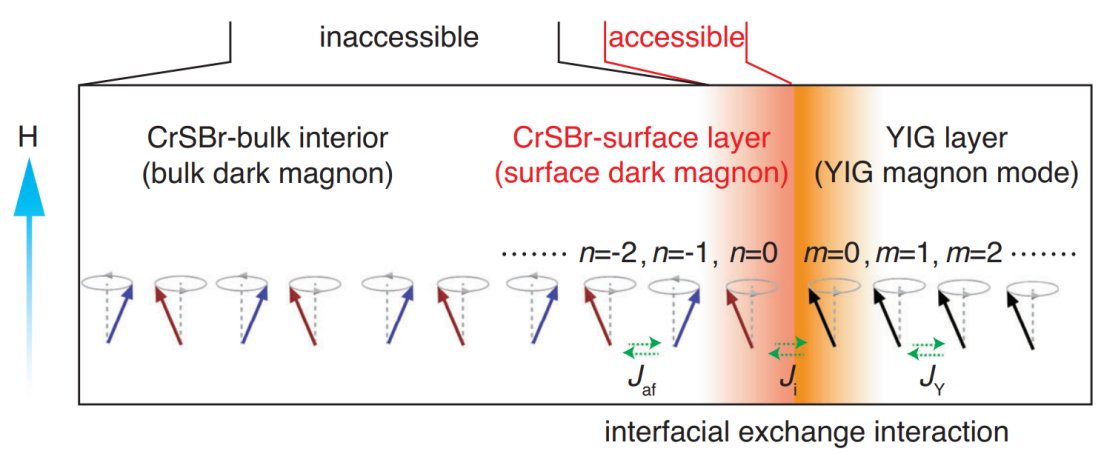
Figure 2 Theoretical interpretation of the dark mode at the CrSBr interface.
This work demonstrates the experimental detection of dark magnons in a van der Waals antiferromagnetic system and establishes an effective approach to their excitation and detection through interfacial exchange coupling, overcoming a longstanding experimental challenge. Beyond advancing the understanding of antiferromagnetic spin-wave dynamics and interfacial coupling mechanisms, this finding opens new possibilities for developing antiferromagnetic magnonic devices, low-power on-chip integrated magnonic circuits, and magnon-based quantum information processing.
The Shenzhen International Quantum Academy is the first affiliation of this work. The co-first authors are Kanglin Yu, a visiting student at IQASZ; Hanchen Wang, a PhD student at ETH Zurich; Chenyan Hu, a jointly supervised PhD student at IQASZ and SUSTech; and Yu He, a PhD student at Beihang University. Hanchen Wang, Prof. Timothy Ziman from the Institut Laue-Langevin, Prof. Haiming Yu from Beihang University, and Prof. Jilei Chen are the corresponding authors. This work was supported by the National Key Research and Development Program of China, the National Natural Science Foundation of China, the Department of Science and Technology of Guangdong Province, and other funding agencies.
Paper Link :https://www.nature.com/articles/s41467-026-78521-w